
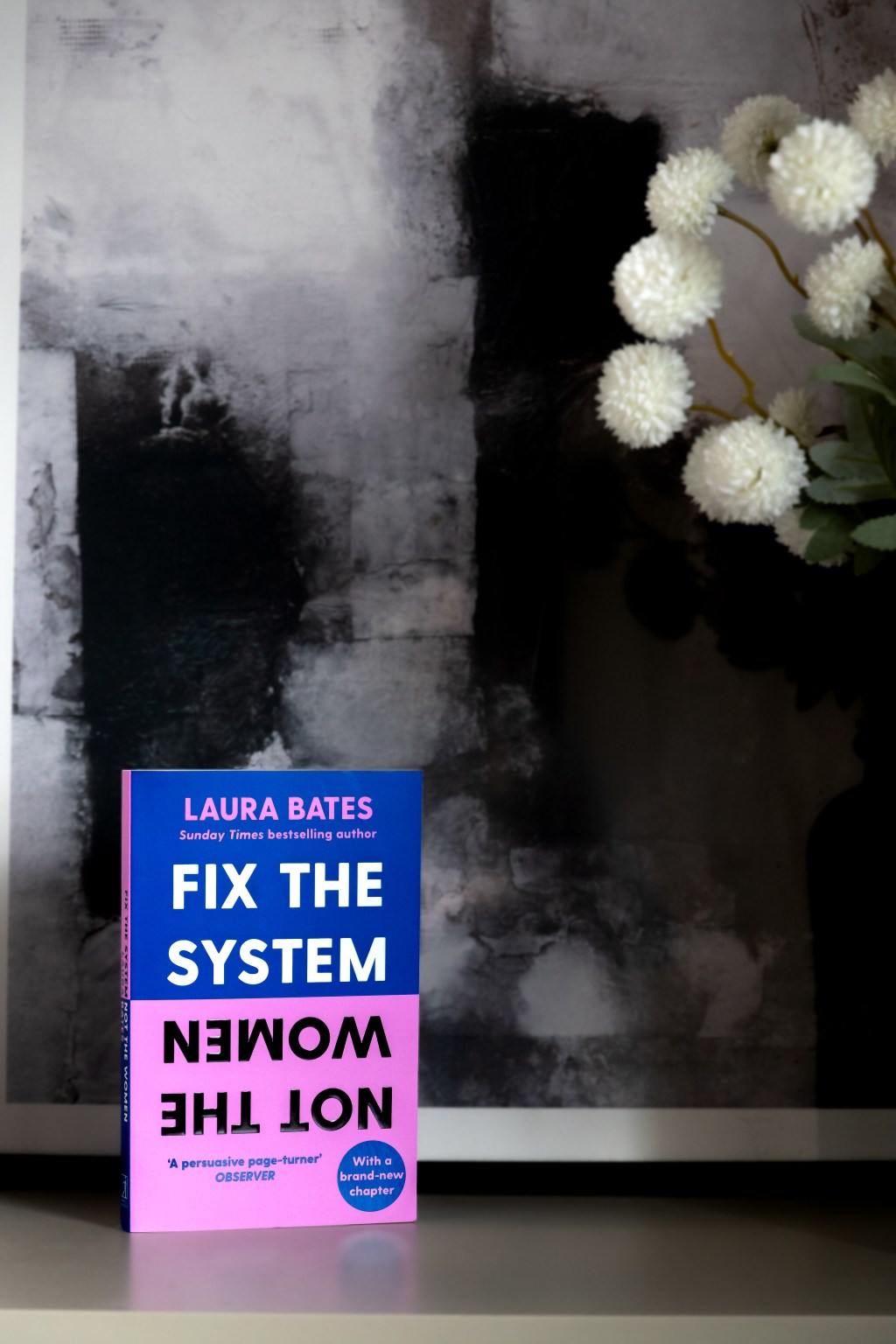
Reading Mood: I want something sharp and thought-provoking
Rating: ★★★★★
Content Warnings: Rape, sexual assault, domestic abuse, sexual harassment, victim-blaming, police misconduct, violence against women and girls.
Quick Verdict
Fix the System, Not the Women is a furious, exhausting, deeply necessary read about the systems that keep failing women and then somehow still expect women to be the ones to change.
I found this book shocking, but also not shocking – which might be the most depressing thing I can say about it. So many of the statistics are horrifying. So many of the examples are enraging. And yet, very little of it feels surprising, because the patterns Laura Bates writes about are everywhere: in schools, workplaces, politics, policing, the courts, the media, and in the tiny everyday moments women are told not to make a fuss about.
This is a book about misogyny, yes, but more specifically it is a book about power. Who has it. Who abuses it. Who is protected by it. And who is told, again and again, to adapt to it.
What is Fix the System, Not the Women about?
In Fix the System, Not the Women, Laura Bates argues that we have spent far too long asking women and girls to solve problems they did not create.
Women are told to dress differently, walk differently, drink differently, work harder, speak louder, speak softer, report harassment, anticipate danger, manage men’s behaviour, stay safe, be confident, be resilient, be careful, be polite, be angry but not too angry, be assertive but not difficult.
And when something happens anyway?
We ask what she was wearing. Why she was there. Whether she reported it. Why she did not leave. Why she did not shout. Why she did not complain sooner. Why she trusted him. Why she ruined his life. Why she did not protect herself better.
Bates’ central argument is simple and devastating: women were never the problem. The systems are.
The book looks at five major institutions – education, politics, media, policing and criminal justice – and explores the way each of them reinforces the same basic message: women’s pain is individual, women’s safety is personal responsibility, and women’s inequality is something to be solved by women.
That framing is exactly what Bates is trying to dismantle.
The power of this book is in the pattern
The most powerful thing in this book is not any one individual statistic, although plenty of them are appalling. It’s the accumulation.
You read about girls in schools. The women in workplaces. Then women in politics. Then women failed by the police. Then women traumatised by the justice system. Then women blamed in the media. And slowly, horribly, the same shape appears underneath all of it.
It is not an accident.
That is the point that Bates keeps returning to. These are not separate, unfortunate, isolated incidents. They are connected. They form a pattern. And once you see the pattern, you cannot unsee it.
This is why the so-called “minor” things matter so much. Bates is brilliant on the way low-level sexism is dismissed as harmless: jokes, comments, dress codes, casual harassment, victim-blaming, objectification, the constant tiny instructions girls receive about how to make themselves smaller and safer. But the “little things” are not separate from the bigger things. They are the foundation.
A culture that teaches girls that their bodies are distractions is connected to a culture that blames women for male violence. A workplace that treats sexual comments as banter is connected to a workplace where harassment is not taken seriously. A media culture that obsessively judges women’s appearance is connected to a political culture that treats female leaders as inherently more questionable, more scrutinised, more unlikeable.
The small things are not small when they are teaching us what to expect.
The education section made me furious
The section on education was one of the hardest parts of the book for me, because it shows how early these messages begin, and they are messages I remember all too well.
Girls are taught, often before they even have the language to challenge it, that their bodies are a problem. That their clothes are disruptive. That boys’ behaviour is natural, inevitable, almost biological. That girls must modify themselves to prevent boys from acting badly.
That is not neutral. That is not just a dress code. That is a lesson.
It teaches boys that their behaviour is expected and girls that they are responsible for managing it. It teaches girls to internalise blame before they have even fully entered adulthood. It teaches them that if something happens, the first question will not be “who harmed you?” but “what did you do to invite it?”
The statistics Bates draws on are horrifying. Almost a third of girls aged 16 to 18 have experienced unwanted sexual touching at school, and a BBC freedom of information investigation found that 5,500 sexual offences, including 600 rapes, were reported to police as having taken place in UK schools over a three-year period. Bates points out that, taking into account the average UK school term, this amounts to around one rape reported per school day.
That number is almost too awful to process. One rape per day. In schools.
And yet this is the point of the book: these figures do not appear from nowhere. They exist within a wider culture that teaches girls to shrink themselves and teaches boys that their behaviour will be explained away.
The system does not begin failing women only at the point of crisis. It starts much earlier. In classrooms. In uniform policies. In the language used around girls’ bodies. In what adults ignore. In what they punish. In whose comfort is prioritised.
Women are blamed for everything
One of the most relentless themes in the book is blame.
Bates shows how women are blamed across every stage of life. Girls are blamed for distracting boys. Young women are blamed for being naïve, drunk, flirtatious, careless, dramatic. Working women are blamed for not being assertive enough, then punished when they are. Mothers are blamed for childcare gaps, career gaps, relationship failures, children’s behaviour, men’s failures. Victims are blamed for not reporting. Or for reporting. Or for reporting too late. Or for not seeming upset enough. Or for seeming too upset.
The blame always seems to find its way back to women.
What Bates does so well is show that this is not just cultural noise. It serves a purpose. If women can be convinced that what happens to them is the result of their own weakness, choice or failings, then nobody has to properly examine the systems that allowed it to happen.
Not misogyny. Not institutional racism. Not male violence. Not poor workplace protections. Not a broken criminal justice process. Not police misconduct. Not media narratives that dehumanise women. Not politics built around male norms of power.
Just women. Again. Somehow.
This is why the book feels so validating as well as infuriating. It gives language to something many women know instinctively: that the problem is not that we have failed to become sufficiently careful, confident or resilient. The problem is that we are living inside systems designed to shift responsibility away from power and onto the people harmed by it.
The workplace section is bleak because it is so believable
The workplace section was another part of the book that felt horribly familiar.
Bates writes about sexual harassment at work not simply as a matter of individual bad behaviour, but as a systemic failure. The issue is not just that harassment happens. It is that workplaces so often make it difficult, risky or pointless to report.
The numbers are grim. TUC research found that more than half of women had experienced some form of sexual harassment at work, rising to nearly two-thirds of young women. But what really stayed with me was not just how common harassment is – it was how little changes when women do report it.
Of the women who told someone at work about their experience, nearly three-quarters said nothing changed. A further 16% said said they were treated worse. That means only a tiny minority (9%) of women saw any positive outcome from reporting.
So when people ask, “Why didn’t she report it?” the better question might be: why have we built systems where reporting so often fails women?
That is what makes all the “speak up” messaging feel so hollow. Women are told to report harassment, but what happens when they do? Are they believed? Protected? Taken seriously? Or are they quietly marked out as difficult, dramatic, oversensitive, risky?
A policy is not the same as protection. A complaints process is not the same as safety. A line in an employee handbook does not mean much if the culture punishes the person who uses it.
This is where Bates’ title does so much work. Because again, the demand is usually placed on women. Report it. Escalate it. Evidence it. Endure the consequences. Keep working alongside him. Stay professional. Don’t let it affect your career. Don’t be bitter. Don’t be emotional. Don’t be difficult.
But the problem is not women’s failure to report. The problem is what happens when they do.
Policing and criminal justice are the hardest sections to sit with
The sections on policing and criminal justice are brutal.
Bates writes about the way women are failed at the very point when they are most in need of institutional protection. These chapters are not just about individual officers, individual cases or individual miscarriages of justice. They are about trust — and what happens when women are told to trust systems that have repeatedly shown they cannot be trusted.
The policing section is especially difficult because it deals with both failure and power. When allegations of sexual misconduct involve police officers themselves, the betrayal feels almost impossible to process. Women are told to report violence to the police. But what happens when the institution they are told to turn to has its own deep-rooted problems with misogyny, abuse and accountability?
One of the most shocking statistics Bates cites is that almost 600 sexual misconduct allegations were made against Metropolitan Police officers between 2012 and 2018, with only 119 upheld. The reported examples include an officer dismissed after having sex with a rape victim and another alleged to have assaulted a domestic abuse survivor.
It is hard to read that and still treat these as isolated incidents.
The criminal justice section is just as enraging. Bates is sharp on the language around rape and sexual violence: the way terminology can soften, blur or sanitise what has happened. We often see rape described as “non-consensual sex”, as though the violence of the crime needs to be made more palatable. But we would never call theft “non-consensual borrowing”. We would never call kidnap a “non-consensual excursion”.
That point really stayed with me. Language is not cosmetic. It shapes seriousness. It shapes public understanding. It shapes whose pain is recognised and whose is made easier to ignore.
And Bates is not simply arguing that the answer is longer prison sentences or harsher punishments in isolation. Her point is bigger than that. It is about the fact that our treatment of rape and sexual violence is completely inadequate when measured against the seriousness of the harm. The process can be retraumatising. The scrutiny is often turned back onto the victim. Myths about rape remain stubbornly embedded. Justice is uncertain, delayed or absent.
It is hard to read because it is hard to deny.
Why this book works so well
What makes Fix the System, Not the Women so compelling is that it does not let the reader stay at the level of sympathy. It asks for analysis.
It is not enough to say, “that’s awful.” Bates wants us to ask: who benefits from this being framed as an individual problem? Who is protected when women are blamed? Who has the power to change the system? Who keeps avoiding accountability?
That is the political force of the book. It moves the conversation away from women’s behaviour and towards institutional responsibility.
It also connects forms of misogyny that are too often treated separately. School dress codes, workplace harassment, media sexism, police failures, low conviction rates, political double standards, victim-blaming — Bates shows these are not random fragments. They are part of the same structure. Different rooms in the same terrible house.
And once you understand that, the title becomes more than a slogan. It becomes an instruction.
Stop asking women to accommodate the problem.
Fix the system.
Did I enjoy reading it?
Enjoy is probably the wrong word.
I valued it. I admired it. I underlined a lot. I wanted to throw it across the room several times. I wanted to make people read it. I wanted to discuss it immediately. I wanted, quite dramatically, to stand in a kitchen with a glass of wine and rant about it for two hours.
So no, it is not an enjoyable read in the cosy sense.
But it is incredibly readable. Bates writes with clarity and momentum, and despite the heaviness of the material, the book never feels academic or inaccessible. It is direct, urgent and compelling. It is the kind of non-fiction that makes complex systems feel visible.
That said, I would definitely recommend going into it with care. The content is heavy, particularly around sexual violence and violence against women. It is the kind of book you might need to read in sections rather than all at once.
Final thoughts
Fix the System, Not the Women is a furious, necessary and deeply clarifying book.
It is shocking because the evidence is shocking. But it is not shocking because the patterns are already so familiar. That is what makes it so devastating. Bates is not revealing a hidden world so much as naming the world women already live in.
This is why Bates’ insistence on the word “pattern” matters so much. Worldwide, women and girls are killed by intimate partners or family members every day — not rarely, not exceptionally, not as freak anomalies, but with devastating regularity. Recent UN data puts the figure at around 137 women and girls killed every day by partners or family members. These are not isolated incidents. They are the opposite of isolated incidents. They are a pattern.
The book left me thinking about how much energy women are asked to spend adapting to systems that were not built for them. How much advice is really just blame in a nicer outfit. How often “empowerment” is used to avoid accountability. How many times women are told to change their behaviour instead of asking why the burden is on them in the first place.
We have spent decades telling women and girls how to fix themselves.
Be safer. Be stronger. Be more confident. Be quieter. Be louder. Be less angry. Be more careful. Be more resilient. Be more forgiving. Be less difficult. Be more aware. Be less visible. Be everything, apparently, except free.
Laura Bates’ argument is clear: enough.
Women were never the problem.
Fix the system.
 Books With Megz