
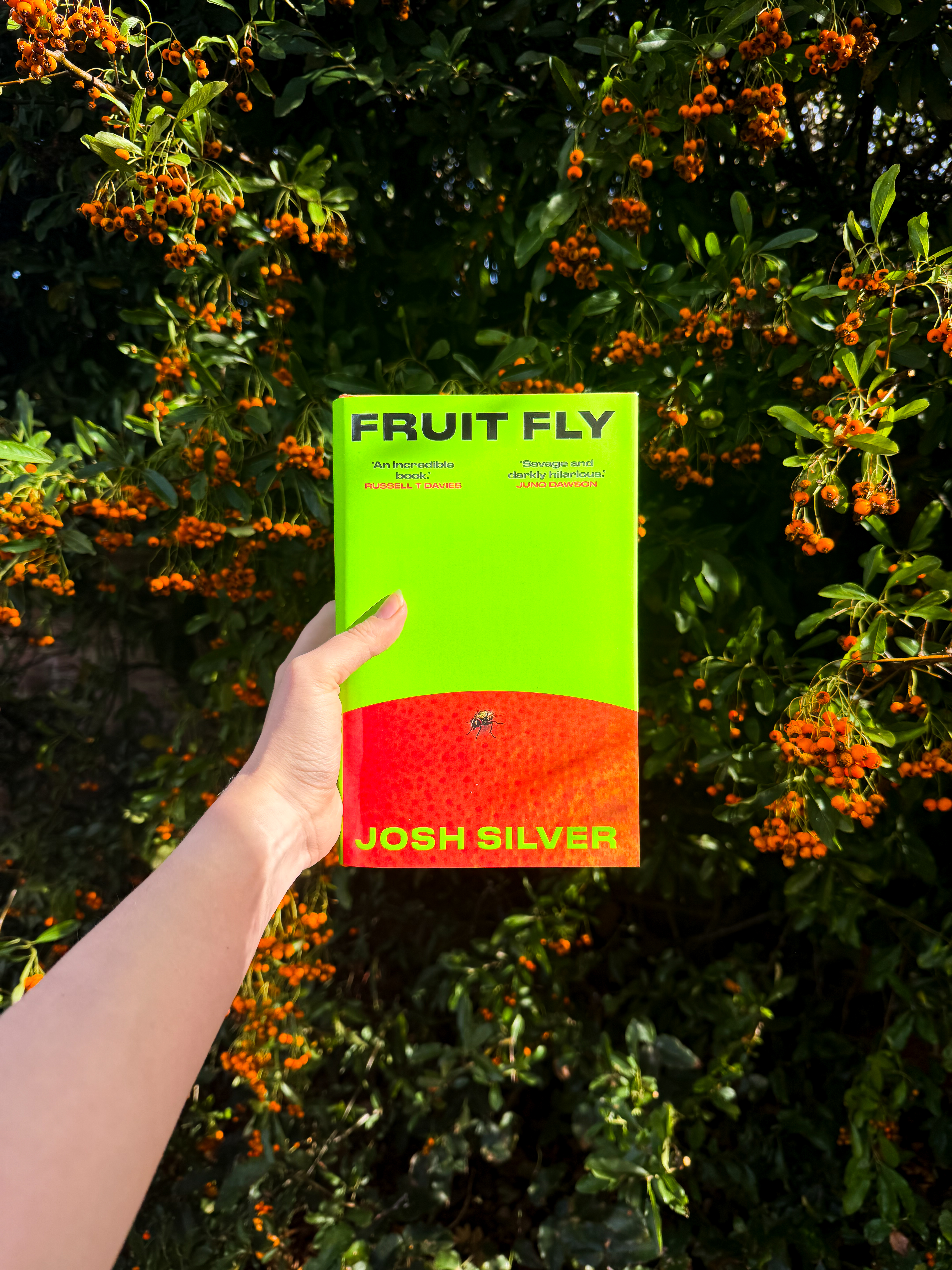
I picked up Fruit Fly because I had seen so many glowing reviews of it on Bookstagram that eventually curiosity got the better of me. Despite that, I somehow managed to go into it knowing remarkably little about what it was about.
Fruit Fly is one of those books that starts in one place and very gradually becomes something else entirely. At first, I thought I was reading a sharp, slightly deranged satire of publishing, status and the performance of having your life together. By Part 3, it had become something much darker and genuinely tense.
I finished it, closed the book and wrote in my review notes: flawless – no notes! Honestly I was hooked (read it in a day).
A life that looks better from the outside
Mallory is a novelist whose first book was published seven years ago.
It was supposed to be the beginning of everything. The book was successful, there was talk of a film adaptation, and presumably another novel would follow.
Except it didn’t. The adaptation disappeared. The second book never materialised. Seven years later, Mallory is still measuring herself against that brief moment when it looked as though her career was about to become something much bigger.
Meanwhile, everyone around her appears to be moving forwards.
Her husband Ronan is successful. Her friends are successful. Her house is beautiful. From the outside, Mallory has a life plenty of people would envy, but she is miserable. She is also deeply concerned with how that life looks to everyone else.
This is where I found her simultaneously hilarious, frustrating and surprisingly sad.
She has the right books lying around. She talks about where her furniture is from. She calls Ronan “my love” in front of other people even though that isn’t how they speak to one another privately.
My favourite ridiculous detail, though, is her car radio.
Mallory keeps it tuned to 6 Music, despite hating it for being so “plinky-plonky and glockenspiel-y”, but she wants people to hear it when they get into her car so they believe that her taste in music is “peripheral and therefore edgy”. In reality, she loves Abba and the Scissor Sisters.
It’s such a small thing, but it tells you almost everything about her. Mallory is constantly performing the version of herself she thinks other people will value.
Even the people around her are filtered through that same lens. Early on, she observes a group of smokers as though their Tate Modern memberships and Birkenstocks somehow makes them too interesting to worry about lung cancer.
Everything is taste. Everything is status.
And even though I found this incredibly irritating, I also understood some of it.
She had created a roadmap for what her life was supposed to look like. When her career stopped following it, the rest of her life seemed to lose value with it. When so much of your sense of worth comes from professional success, it can be very difficult to appreciate everything else around you when that one part isn’t going to plan.
It’s something I can definitely relate to.
When inspiration becomes exploitation
Then Mallory meets Leo.
Leo is young, gay, homeless and struggling with addiction. Very quickly, Mallory begins to see him as a story rather than a person.
At first, there is perhaps a version of this where I could understand what she was doing. Writers take inspiration from people they meet, conversations they overhear and things they experience all the time, but Mallory goes considerably further than inspiration.
She follow Leo, attends a support meeting and pretends to be an alcoholic, engineers a way into his life, encourages him to confide in her, and then goes home and turns those conversations into materials for her novel.
There was a very obvious point for me when inspiration ended and theft began, and Mallory sprinted way past it.
The uncomfortable thing is that she is remarkably good at justifying it to herself – she isn’t exploiting Leo, she is writing something important, she isn’t invading his privacy, she is doing research.
Every time another boundary moves, she finds a new reason why this particular boundary is acceptable, and the publishing industry helps push her further down this path with glowing reviews on her manuscript.
“Go gay. Gay sells”
Silver is not particularly subtle about what he thinks of the machinery surrounding Mallory’s book.
At one point the advice essentially boils down to: “Go gay. Gay sells.”
Elsewhere, Mallory reduces the industry’s appetite even further: the real commercial gold dust is apparently being “gay AND sad”.
It is brutal, funny and horribly believable. Identity is valuable but particularly when it can be paired with suffering.
Trauma becomes something marketable.
That is probably what makes Mallory’s pursuit of Leo so uncomfortable. She isn’t simply fascinated by him as a person, she has stumbled across the exact type of story the industry around her has taught her has value.
The more painful it is the more authentic it appears, and the more authentic it appears the more valuable it becomes.
But this just means that gradually, the human being at the centre of the story becomes secondary to what can be made from him.
Addiction isn’t an aesthetic
One element of Mallory’s behaviour bothered me more than almost anything else in the entire novel – the way she initially treats addiction.
She is fascinated by it. Definitely not particularly empathetic nor particularly informed.
At the support meeting that she gate-crashes, she looks around at the people there and thinks: “It doesn’t feel very Euphoria.” That tells you a lot.
She filters addiction through television and pop culture. She even seems to imagine a strange hierarchy of suffering where being an “addict” carries more weight than being an alcoholic because it sounds more hard-core.
I hated this. Addiction isn’t edgy. It isn’t glamorous or culturally interesting. It destroys people, and it hurts the people who love them. Watching Mallory treat someone else’s addiction almost like an authenticity exercise for her novel made my skin crawl.
However, it did make her development a bit more interesting, because her relationship with Leo does change. Initially, he is obviously very material – he represents access to a world she doesn’t understand and a story she believes might finally resurrect her career.
Eventually, though, her concern for him becomes real. She worries about him. She wants him to recover. And, importantly, when the people around her want Leo’s fictional counterpart to have a darker fate because it would make for a better story, Mallory is conflicted because she wants to give him something happier.
It definitely doesn’t erase what she did to get the story in the first place, but it did make the morality slightly less tidy.
Two deeply flawed people, not a villain and a victim
Leo could very easily have become nothing more than Mallory’s victim.
Instead, Silver gives him his own voice and enough complexity that the relationship between them becomes much harder to categorise.
Leo lies. He manipulates people. He exaggerates his circumstances when it benefits him. His addiction has also caused enormous damage to the people around him.
When we learn more about his family, we see just how much they have already sacrificed trying to help him. His parents have re-mortgaged their home and when he returns home after six months, he notices that his mother seems older and neither of them looks particularly happy. His dad eventually asks him to leave.
There is no attempt to pretend Leo’s behaviour only hurts Leo, but underneath all of that is someone incredibly vulnerable. More than anything, he wants to feel loved. He wants someone to hold him, tell him he’s handsome, tell him he matters and make him feel as though he isn’t completely alone.
This really helped him to feel like a person rather than a symbol of addiction.
And loneliness, I think, is much more important to Fruit Fly than I initially realised. At one point Leo reflects: “We will never truly know anyone.”
For a book populated by people constantly performing themselves for everyone else, that line landed. Mallory wants to be seen as successful, interesting and culturally relevant and Leo wants to be seen as lovable. Stacey has quite literally remade the way she presents herself to the world, and even Ronan maintains a version of himself that looks very different from the person Mallory experiences privately.
Everyone wants to be seen, but very few of them seem to feel genuinely known.
Everyone is addicted to something
One of my favourite ideas in Fruit Fly is that addiction doesn’t stop with Leo – his dependency is simply the most obvious.
Mallory is addicted to success and validation. She wants another book, another moment of relevance, some confirmation that her first success wasn’t a fluke. She needs the publishing world to tell her that she is talented and worthwhile again.
Her mum, Stacey, seems addicted to presenting a particular version of herself. The accent, the clothes, the nails — everything is part of creating the person she wants the world to see.
And then there is Ronan, who wants power and control.
What connects all of them is that they understand far more about themselves than you might expect.
Mallory can recognise her insecurities, and Leo knows many of his own patterns, yet that self-awareness doesn’t necessarily result in change. Sometimes it simply gives them better language with which to rationalise their behaviour.
Understanding why you do something and actually stopping yourself from doing it are two very different things.
The point where everything gets darker
For me, Part Three is where Fruit Fly changed completely.
Until then, I had mostly been reading it as a dark social satire with increasingly uncomfortable undertones. Then Ronan becomes frightening.
He takes Mallory’s phone, isolates her, keeps her inside the house, makes her delete Slay and tries to force her into writing something completely different. Most disturbingly, is that he repeatedly tells her that she is mentally unwell.
The tension suddenly isn’t coming from Mallory’s questionable decisions or Leo’s addiction – it’s coming from her marriage.
There is a line earlier in the novel where the bed slats groan beneath the mattress, as though trying to remind Mallory that there are “cracks, out of sight, waiting.”
At the time it is an unsettling little image – a foreshadowing of sorts.
This did change how I felt about Mallory. Earlier in the novel, I was frustrated by how much resentment she appeared to hold towards Ronan because it seemed that he was initially supportive. By this point though, I felt incredibly protective of her.
Mallory exploiting Leo does not mean she cannot also be a victim. Her own suffering does not erase the harm she causes somebody else. Leo can manipulate and hurt people while still deserving empathy. Nobody is allowed to occupy one convenient moral category.
These moral quandaries made Fruit Fly such an enjoyable and thoughtful read.
Who gets to own a story?
The question running underneath all of this is fairly simple: Who gets to tell someone else’s story?
Before reading Fruit Fly, I would have said that there are circumstances where it is perfectly valid.
Someone else’s experience can inspire fiction. Stories can preserve the experiences of people who are no longer able to tell them themselves. I don’t think identity has to create an absolute boundary around what a writer is allowed to write.
I still don’t. But Fruit Fly made the question considerably more uncomfortable, because it isn’t only about who technically has the right to write something. It is about power.
Mallory has a home, money, professional connections and publishers willing to listen.
Leo has considerably less security and considerably less control over what happens to his story once it has been given to someone else.
It’s also not like Mallory is packaging up someone else’s story that wouldn’t be able to tell it themselves. Leo is a writer himself, a poet, with outstanding grades in creative writing. He had the ability to put his own story out there if he so wished.
Then there is the publishing machine itself. Every time Mallory steps further across the line, she is rewarded, and encouraged to immerse herself further. Make it darker, more authentic, make it hurt.
Suffering appears to have value when somebody knows how to package it properly, which is one of the ugliest ideas in the novel.
Trauma becomes cultural currency.
And somewhere along the way, everyone becomes so interested in whether the story is good that the question of who was hurt to produce it becomes secondary.
The rotten fruit underneath
There is a moment late in the novel where Mallory notices fruit flies around the dining table. There is apparently fresh fruit sitting there, but underneath it she discovers a rotten tangerine she had missed.
This immediately felt like the key to the title for me. Everything looks fine from above, but there’s rot underneath.
That rot describes almost every person and relationship in this book – Mallory’s marriage, her carefully curated identity, her mum’s reinvention of herself, Ronan’s charm, and Leo’s lies.
Everyone has something underneath the version they show everybody else. To me that is the point, that there is a rotten piece of fruit in everybody, but some people’s is simply easier to see.
An ending that refuses to behave
I knew what I wanted from the ending, and that was for Leo to break the cycle. I wanted him to keep going to meetings, reconnect properly with his family and finally find some stability.
Essentially, I wanted Fruit Fly to reward me for caring about him.
That isn’t quite what it gives us.
The final scene, left me deeply uneasy.
There are things that remain unresolved. Mallory doesn’t necessarily feel completely stable. Leo’s intentions are unsettling. Whatever connection exists between them has not simply disappeared because the central events of the novel have ended.
It would have been very easy to wrap everything up with recovery, redemption and the suggestion that everybody had learned something.
Instead, Fruit Fly leaves open the much more uncomfortable possibility that people can change their circumstances without fundamentally changing themselves.
A new beginning doesn’t necessarily mean becoming a new person.
Final thoughts on Fruit Fly by John Silver
I went into Fruit Fly almost completely blind because Bookstagram had convinced me I needed to read it, and I’m so so glad that I picked it up.
My feelings towards these characters changed constantly. Mallory could make my skin crawl in one chapter and have me desperately wanting to protect her a few chapters later. Leo could manipulate everyone around him while still being somebody I badly wanted to see get better.
Almost everyone in this book behaved terribly at some point, yet I cared about them (apart from Ronan).
Fruit Fly manages to be funny, uncomfortable, ridiculous and genuinely sinister without any of those elements cancelling the others out. It has plenty to say about publishing, addiction, class, identity and creative ownership, but it never became a novel that felt as though it existed solely to make its argument.
At its centre are simply a collection of very messy, often very lonely people trying to get something they desperately want, whether that be love, success, control, validation, or a second chance.
Sometimes they hurt other people to get it, and sometimes they hurt themselves. Sometimes they hurt themselves. And sometimes they know exactly what they are doing and do it anyway.
Towards the end, the novel offers the much more optimistic thought that underneath everything, perhaps we are all connected.
I actually think Fruit Fly earns that sentiment because it has spent the previous hundreds of pages showing us the considerably uglier version of the same idea.
We are all capable of wanting to be loved. We are all capable of being lonely. And, unfortunately, we are all capable of having something slightly rotten underneath.
I finished it and genuinely had one thought: Flawless. No notes.
Rating: ★★★★★
Read this if you like: morally messy characters, dark social satire, publishing-world novels, addiction narratives, psychological thrillers and books that make it almost impossible to work out who you are supposed to be rooting for.
One response to “Fruit Fly by John Silver: Ambition, Addiction and Who Gets to Own A Story”
[…] character is looking for it somewhere. That search for belonging reminded me a little of Fruit Fly, another recent read that explores identity and the often strange ways people try to find their […]