
Quick Verdict
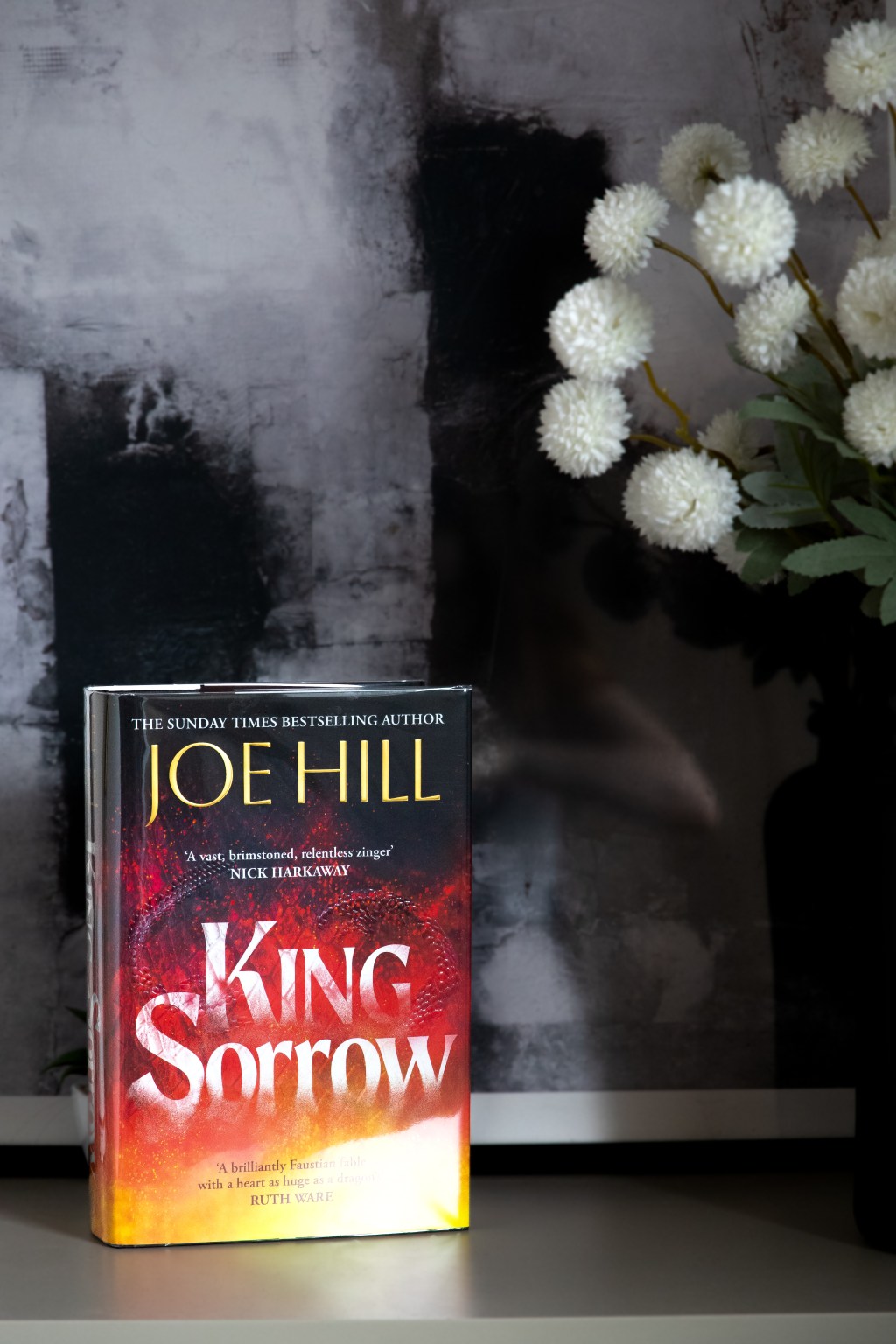
King Sorrow by Joe Hill is a huge, ambitious, genre-blending horror-fantasy epic about friendship, storytelling, dark bargains and the terrible consequences of summoning something you do not fully understand.
This was a Goldsboro PREM1ER book that I received last year and then, quite frankly, slightly avoided because it is absolutely massive. At nearly 900 pages, it is definitely the longest book I have ever read, and it is not necessarily the kind of book I would usually pick up for myself.
But this is exactly why I love a good book subscription. Sometimes you need someone else to put a book in your hands and say, “Trust us.” And in this case, I am very glad that I did.
I went in mildly intimidated and came out genuinely impressed. King Sorrow is dark, strange, dramatic, occasionally very funny, and far more readable than a book of its size has any right to be. For something so far outside my usual reading lane, this ended up being a real surprise — and a brilliant reminder of why I trust the Goldsboro team.
What is King Sorrow About?
The novel begins at Rackam College in Maine in the late 1980s, where Arthur Oakes is a bookish student who becomes caught up in a dangerous situation involving local criminals, blackmail and the theft of rare books.
When Arthur and his friends discover an occult text with instructions for summoning a dragon-like entity from another world, they make a desperate decision. They call on King Sorrow.
And, because this is a horror novel and not a sensible university safeguarding lecture, the plan goes catastrophically wrong.
King Sorrow does help them (in a manner of speaking) but his help comes at a price. A terrible, ongoing price. What starts as a desperate solution becomes a lifelong bargain, pulling the group into decades of fear, guilt, loyalty, betrayal and moral compromise.
This is one of those books where the premise sounds almost absurd when you summarise it, but Joe Hill commits so fully to the world, the characters and the consequences that it works.
The size is intimidating, but the story moves
Let’s talk about the obvious thing: the book is enormous.
I do not think I have ever picked up a book and felt so immediately aware that I was making a lifestyle choice. This is definitely not a “pop it in your handbag” book. This is a “cancel your plans and strengthen your wrists” book.
And yet, once I got into it, I was surprised by how quickly it moved.
For a book of this length, King Sorrow is impressively readable. It does not feel like one long slog. It shifts shape as it goes: part dark academia, part supernatural horror, part fantasy quest, part coming-of-age story, part decades-spanning friendship saga. There are moments of violence and dread, but also humour, tenderness, absurdity and real emotional consequence.
That range is probably what kept me going. If the whole book had stayed in one mode for nearly 900 pages, I think I would have struggled. But Hill keeps widening the lens. The story begins with a group of young people doing something reckless and terrifying; then it becomes a story about living with what they have done.
That was the part I found most interesting.
The Goldsboro effect
I received King Sorrow through Goldsboro’s PREM1ER subscription, and I honestly think that made a difference to whether I read it.
Left to my own devices, I am not sure I would have picked this up. Not because it did not sound good, but because it looked so far outside my usual lane. A giant horror-fantasy epic about a dragon was not necessarily screaming “Megan, this one’s for you.”
But I do trust the Goldsboro team’s taste, and that trust paid off here.
This is exactly what I want from a subscription: not just books I already know I want, but books that gently shove me out of my comfort zone and make me realise I might be more flexible than I thought. Annoying when that happens, but ultimately good for character development.
King Sorrow reminded me that sometimes the books that look least like “your thing” can still completely pull you in.
Dark academia with actual darkness
One of the things I enjoyed most was the dark academia atmosphere.
The early sections at Rackham College have that irresistible mix of libraries, rare books, clever students, secrets, intellectual arrogance and extremely poor decision-making. There is something deliciously unsettling about academic spaces being used as gateways to something ancient and monstrous. Books are not just books here; they are objects of power, temptation and danger.
That worked very well for me.
But the novel does not stay in cosy dark academia territory. It becomes much darker and more expansive. The summoning of King Sorrow is not a quirky gothic flourish; it is the event that warps the rest of these characters’ lives. The book is interested in what happens after the dramatic ritual, after the immediate danger, after the mistake has already been made.
How do you live with a bargain you cannot undo?
How do friendships survive shared guilt?
What do people become when they have to keep choosing who pays the price?
That is where the book has real weight. The supernatural element is huge and dramatic, but the emotional horror is in the consequences.
King Sorrow himself is wonderfully menacing
A dragon could easily have tipped this book into something too silly for me, but King Sorrow is genuinely frightening.
He is not just a monster. He is mythic, cruel, intelligent and deeply bound up with storytelling itself. There is something very old-world and folkloric about him, but also something psychologically sharp. He is not frightening only because he can kill; he is frightening because he turns human weakness into a structure.
The annual sacrifice element gives the book its central moral pressure. It is one thing to make a terrible choice once in a moment of panic. It is another thing to keep living inside that choice year after year.
I really liked that Hill does not let the characters off the hook. The book keeps asking uncomfortable questions about complicity, responsibility and rationalisation. If you choose someone “bad” as a sacrifice, does that make it better? Who gets to decide who deserves punishment? At what point does survival become collaboration? How many times can you justify doing the wrong thing before it becomes who you are?
For all the dragons and dark magic, those questions felt very human.
The friendship group is messy in the best way
The central group dynamic is one of the book’s biggest strengths.
These characters are not all equally likeable — which, frankly, is often more interesting. They are clever, damaged, selfish, loyal, frightened, ambitious and sometimes awful. Their relationships shift over time, and the bond created by what they have done is not straightforwardly romanticised.
I liked that the book treats friendship as something powerful but not automatically pure. Shared history can be a comfort, but it can also be a trap. Secrets bind people together, but they can also curdle into resentment. The group’s connection is built on love, guilt, fear and mutual destruction, which is obviously very inconvenient for them but excellent for the reader.
As the years pass, the book becomes less about whether they can escape King Sorrow and more about what kind of people they become while trying.
That was where I felt most invested: not just in the horror of the bargain, but in the emotional and moral erosion that followed.
It is not normally my kind of book — and that was part of the fun
This is not the sort of book I usually reach for.
I like dark and atmospheric reads, but I am not usually a big horror-fantasy-doorstopper person. Dragons, occult rituals, decades-spanning supernatural bargains — these are not generally the first things I search for when looking for my next read.
But I think that is why I enjoyed it so much.
There is something really satisfying about being surprised by a book. King Sorrow asked me to go with it, and once I did, I found myself much more absorbed than I expected. It is bold, strange and dramatic, but also very readable. It has enough human messiness to keep the fantasy grounded and enough mythic weirdness to make it feel distinct.
It was also a useful reminder that reading outside your usual taste can be fun when the storytelling is strong enough.
Would I now become a full-time giant horror epic reader? Probably not. I have my limits and my wrists have rights.
But would I read more Joe Hill? Absolutely.
What worked less well for me
Although I really enjoyed this, I do think the length will be a barrier for some readers.
There were moments where I felt the scale of the book. Not necessarily in a bad way, but it is a commitment. The plot sprawls, the timeline stretches, the cast is large, and the book moves across different tones and genres. For the most part, I enjoyed that expansiveness, but I can also imagine some readers wishing it had been a little tighter.
There were also sections where I was more invested than others. That is probably inevitable in a book this long. When a novel is nearly 900 pages, you are not going to love every single page equally unless you are lying or have achieved a level of literary enlightenment I have not.
But importantly, I never felt like giving up. For a book of this size and outside my usual comfort zone, that says a lot.
Why I am glad I read it
I am really glad I finally picked this up.
It would have been very easy for this to sit on my shelf forever looking beautiful, intimidating and faintly accusatory. Instead, it turned out to be one of those subscription books that reminds you why curated book boxes can be so rewarding.
King Sorrow gave me something different: a big, immersive, dark, imaginative story that I probably would not have chosen for myself but ended up thoroughly enjoying.
And now it has been longlisted for the 2026 Glass Bell Award, which makes me feel even more justified in trusting the Goldsboro team. They clearly knew what they were doing. Rude, but fair.
Final Thoughts
King Sorrow was a genuine surprise for me.
It is the longest book I have ever read, not my usual type of story, and exactly the kind of book I might have admired from a distance without ever actually starting. But once I got past the intimidation factor, I found a dark, imaginative and surprisingly readable epic about friendship, sacrifice, storytelling and the danger of making bargains with things you do not understand.
It is sprawling, dramatic, occasionally brutal and deeply engaging. Most importantly, it made me glad I trusted the subscription and took a chance on something outside my usual lane.
A big book, in every sense, and one I am very pleased I finally read. A 4.5-star read for me.
 Books With Megz