
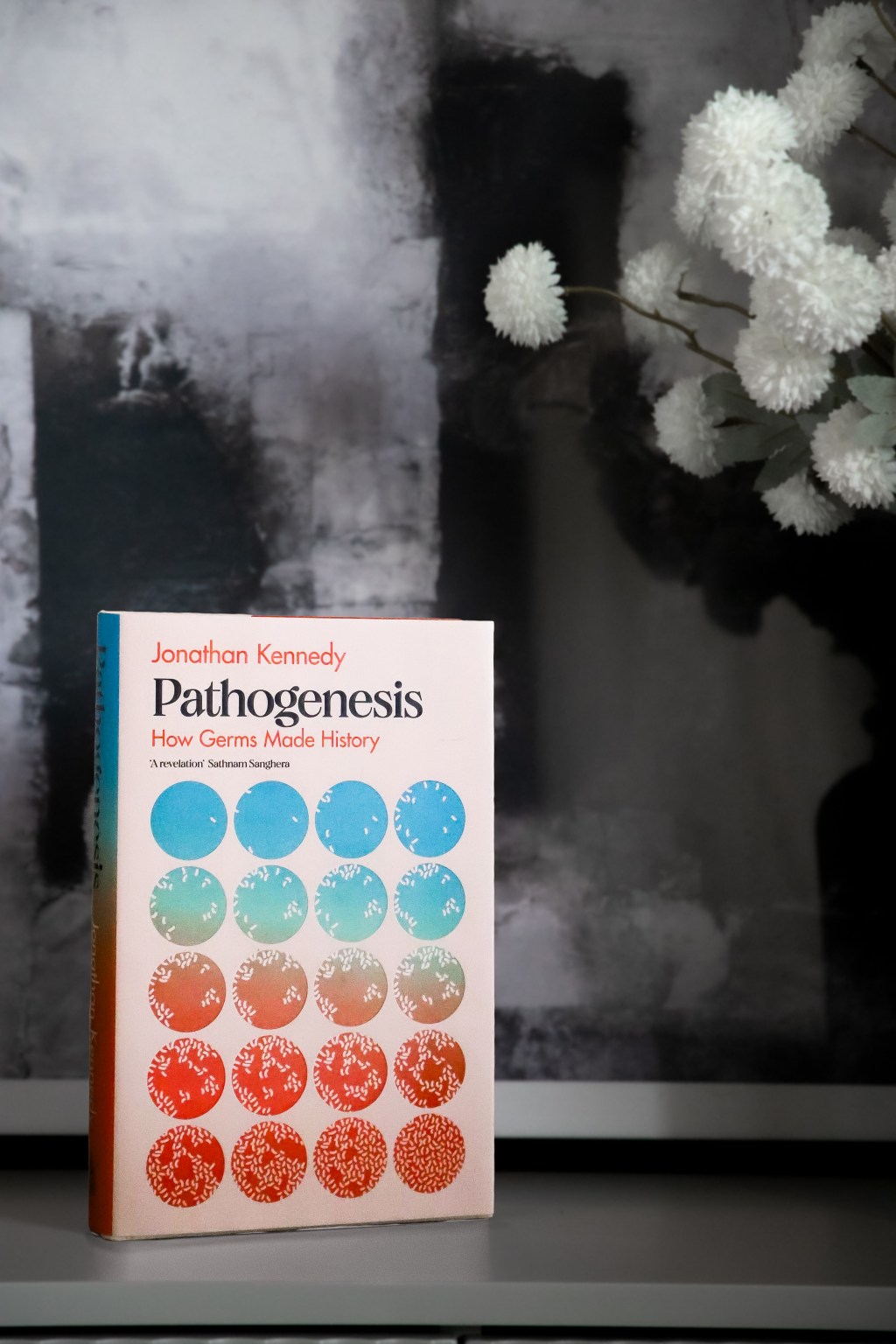
Rating: ★★★★★
I absolutely loved Pathogenesis.
I appreciate that might sound like an odd thing to say about a book covering infectious disease, plagues, colonialism, slavery, famine and several thousand years of human suffering, but this was genuinely one of the most fascinating non-fiction books I have read in a long time.
Jonathan Kennedy’s central argument is deceptively simple: we tend to tell history through kings, wars, inventions, religions and political movements, while vastly underestimating the role that bacteria, viruses and other pathogens have played in shaping the world.
By the end of Pathogenesis, it becomes difficult to look at human history in quite the same way again.
But that is just the beginning of the story.
History, but with microbes put back in
One of the things I loved most about this book is just how enormous its scope is.
Kennedy starts far earlier than the Black Death or smallpox. He takes us right back to evolution itself and the relationship between humans and microorganisms.
And some of the facts were seriously surprising.
There are estimated to be around one trillion different types of bacteria and archaea, while eukaryotic species – animals, plants and fungi included – make up less than 0.001% of species on Earth. Despite bacteria being microscopic, their combined mass is around 35 times that of all animals and 1,000 times the weight of all humans.
That puts our importance brutally into perspective.
But Kennedy’s argument is much more interesting than simply “germs are everywhere”.
He shows that microorganisms haven’t merely attacked us throughout history. They have helped create us.
Around 8% of the human genome consists of DNA originating from ancient retroviruses, and one inherited viral gene appears to play a crucial role in memory formation. Even more astonishingly, a retroviral infection hundreds of millions of years ago contributed to the development of the placenta — meaning that without it, our distant ancestors might have continued laying eggs.
Survival of the best immune system
One of the most compelling ideas running through Pathogenesis is Kennedy’s challenge to our usual concept of evolution.
We tend to imagine survival of the fittest in terms of strenght, intelligence, or dominance. But Kennedy argues that, for huge stretches of human history, one of the most important evolutionary advantages was simply not dying from infectious disease.
Humans with immune systesm or genetic mutations that protected them against particular pathogens were more likely to survive and reproduce – even where those same mutations carried other biological disadvantages.
He then applies this framework to one of the biggest mysteries in human history: why Homo sapiens survived with other human species disappeared.
Modern humans coexisted with Neanderthals and Denisovans, and the evidence increasingly suggests Neanderthals were not simply the primitive cousins we once imagines. People wiht European, Asian or Native American ancestry still carry roughly 2% Neanderthal DNA today, including genetic variants associated with immune responses.
Kennedy explores the possibility that when Homo Spaiens migrated out of Africa, disease may have played a significant rolw in the disappearance of other human populations.
Suddenly our rise to global dominance becomes less: we were smarter and therefore we won; and more: we carried pathogens other humans couldn’t survive. That is a very different story.
Farming may have been a terrible idea
Another section i found fascinating was the transition from nomadic hunter-gatherer societies to agriculture.
We generally treat the agricultural revolution as one of civilisation’s great leaps forward but Kennedy is far less enthusiastic.
Hunter-gathere communities may have had an average lifespan remarkably close to modern global life expectancy once childhood mortality is accounted for, while the adoption of farming led to poorer diets, increased malnutrition and vastly greater exposure to infectious disease from lifestock and stagnant waters.
Settled communities meant more people living together, more interaction with animals, more waster, more trade, and therefore far more opportunities for pathogens to spread.
Plague, hepatitis B tuberculosis and eventually measles all emerged or proliferated in this new environment.
Plagues didn’t just kill people. They changed civilisation.
This is where Pathogenesis becomes much more than a history of disease.
Kennedy’s argument is that epidemics repeatedly altered the political, econommic and religious trajectory of entire societies.
He discusses how diesase weakened Athens during the Peloponnesian War, killing somewhere between a quarter and a third of its army and damaging its military strength for decades.
He then explores the Roman Empire, where the same trade routes and densely connected cities that made Rome extraordinarily powerful also created perfect conditions for epidemics.
Perhaps most provocatively, Kennedy discusses arguments that repeated pandemics helped Christianity grow from a relatively marginal movement into a mass religion. Christian communities provided an appealing framework for understanding suffering and death, as well as caring for the sick, during devastating disease outbreaks.
Later, plague would reshape Europe again.
The Black Death may have killed around 60% of Europe’s populatoin between 1346 and 1353.
The demographic shock gave surviving workers far greater bargaining power. Attempts by landowners and governments to prevent wages rising contributed to social unrest including the Peasants’ REvolt of 1381. Kennedy follows this through into the weakening of feudalism and, eventually, the emergence of a much more commercially dynamic English economy.
The Sections on colonialism are particularly powerful
Some of the most uncomfrtoable chapters concern European colonial expansion.
The devastation caused by Old World pathogens in the Americas is difficult to comprehend: Kennedy cites estimates suggesting the indigenous population of the Americas fell by around 90%, from roughly 60.5 million people in 1500 to just 6 million a century later.
But he flips the disease dynamic when looking at Africa.
For centuries, malaria, yellow fever and other illnesses made much of sub-Saharan Africa extraordinarily dangerous for Europeans. Mortality was so high that European colonisation of many areas was effectively impossible. The increasing use of quinine during the nineteenth century dramatically reduced that barrier.
The connection Kennedy draws between disease and slavery is even more disturbing.
West Africans who had grown up exposed to malaria and yellow fever possessed levels of immunity that Europeans did not. In the Caribbean, this horrifyingly helped make enslaved African labour economically attractive to plantation owners once disease had devastated both indigenous populations and European workers.
Even something as fundamental to modern Britain as the Act of Union enters the story: one historian cited in the book remarks that Great Britain was effectively born with some assistance from Panama’s fevers after Scotland’s disastrous Darien colonial venture.
And the story isn’t finished
Kennedy eventually brings the argument into the modern worls.
One particularly iportant pointis that many infectious diseases are no longer primarily constrained by our ability to treat them.
Tuberculosis still kills around 1.2 million people annually despite the existence of vaccines and antibiotics. Billions of people still lack access to safe sanitation or clean drinking water, resulting in enormous numbers of preventable deaths.
Disease therefore remains closely connected to poverty and inequality.
In England. Kennedy cites figures showing that people living in the most deprived areas are several times more likely to die young from preventable causes than those in the wealthiest areas. During Covid, mortality similarly varied dramatically according to socioeconomic status.
And the final warning is difficult to ignore.
Population growth, climate change, human encroachment into animal habitats and global travel all increase the chances of new pathogens emerging and spreading. Covid was therefore unlikely to be some freak historical interruption. Another pandemic will come eventually; it just may not resemble the last one.
Why I Loved Pathogenesis
The thing that impresed me the most was how readable and accessible all of this was.
Books trying to combine evolutionary biology, genetics, ancient history, economics, epidemiology, colonialism and modern public health have every opportunity to become exhausting. This definitely doesn’t.
Kennedy moves through enormous ideas incredibly smoothly. There is enough science to make the arguments convincing without ever making the reader feel as though they need a microbiology degree to understand what’s going on.
Every chapter keeps returning to the same fascinating question: What if we have dramatically underestimated on of the biggest forces shaping human civilisation?
By the end, Kennedy traces pathogens through the emergence of Homo sapiens, agriculture, ancient empires, world religions, feudalism, capitalism, colonialism and industrialisation.
I’m sure historians could argue over individual links in that chain — and Kennedy is often presenting theories and interpretations rather than pretending every historical question has a single microbial explanation.
But that is also why I enjoyed it so much. And I loved the fact that I’ve read about such a variety of these historical events from different perspectives and I felt like I was obtaining a more holistic view of our human history.
Final verdict
Pathogenesis is exactly the sort of non-fiction I love: ambitious, accessible and absolutley packed with things I immediately wanted to tell someone else (and I definitely did in this case).
I learnt an enormous amount without ever feeling like I was having to work particularly hard to learn it.
If you enjoy books about medicine, science or history, I couldn’t recommend this highly enough.
Rating: 5/5
Read this if you liked: Everything is Tuberculosis, Complications, The Seven Ages of Death – or if you simply enjoy reading a book with approximately 68 new facts you feel compelled to inflict on everybody around you.
 Books With Megz