There is something deeply satisfying about reading about a woman making a terrible decision.
Not terrible terrible, necessarily. Sometimes it’s quitting the sensible job. Sometimes it’s blowing up a marriage. Sometimes it’s becoming fixated on entirely the wrong person. And sometimes it’s spending $20,000 redecorating a motel room approximately half an hour into a cross-country road trip.
You know. Normal behaviour.
I’ve realised that some of the books I enjoy most feature women who are complicated, contradictory, occasionally selfish and very rarely interested in being inspirational. But crucially, they’re interesting.
So if you also prefer your fictional women with slightly more chaos and considerably fewer admirable life choices, here are some of my favourite books that have been living in my head rent free since reading them.
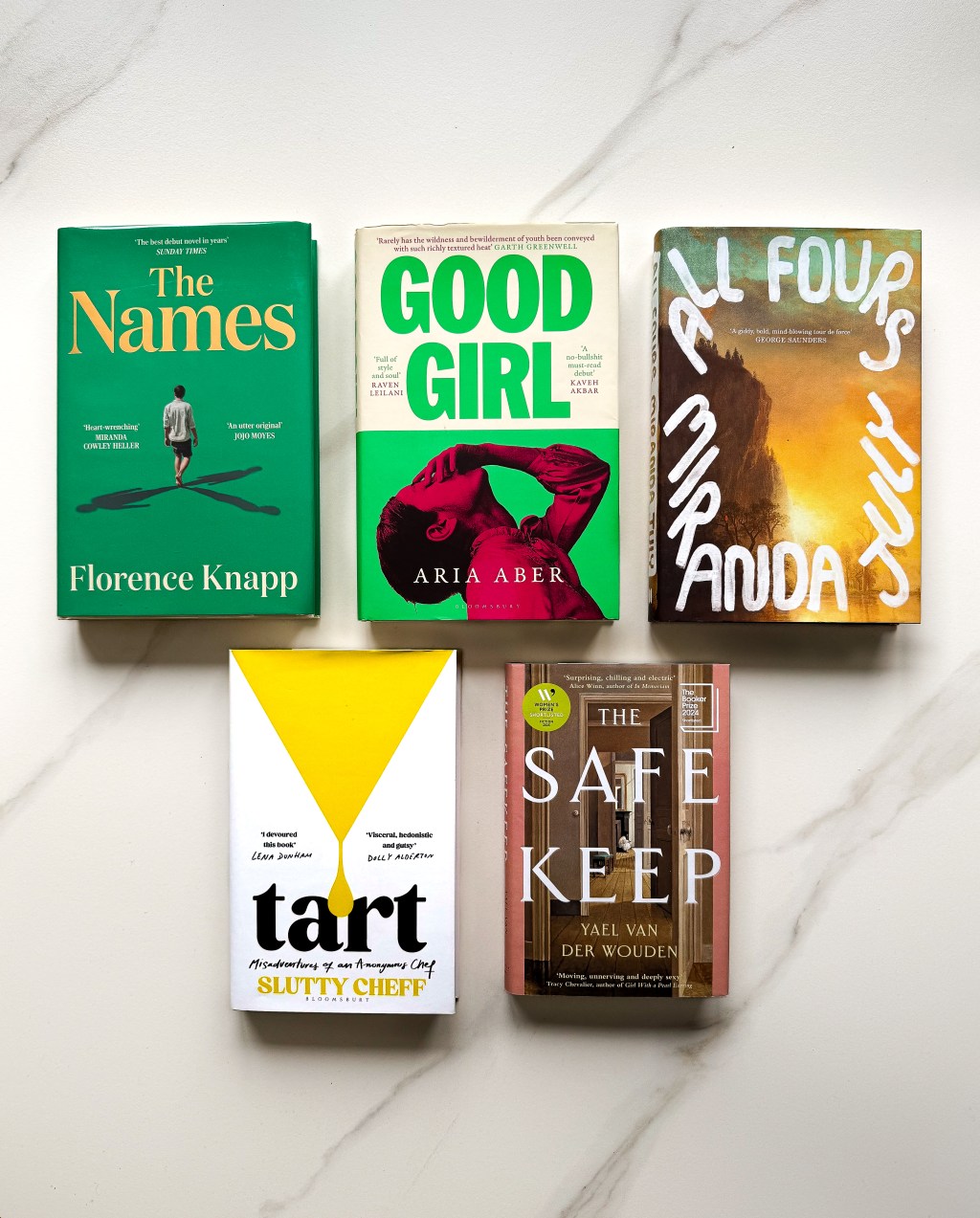
All Fours by Miranda July
For: spectacular midlife chaos
If there were an award for committing fully to a questionable decision, the unnamed narrator of All Fours would be an extremely strong contender.
She leaves Los Angeles intending to drive across the country to New York. She gets about half an hour away.
Then she checks into a motel, spends an extraordinary amount of money redecorating the room and becomes obsessively entangled with a much younger married man.
I gave All Fours four stars, but this is one of those books where the rating doesn’t quite explain my reaction to it. I admired it but it also frustrated to me. It was relatable but completely unrelatable at the same time. And I definitely wanted to shake some sense into the narrator at times.
That being said, I still kept thinking about it afterwards.
What Miranda July captures brilliantly is the particular messiness of a woman realising that the version of herself she has spent decades inhabiting – wife, mother, artist – suddenly doesn’t feel sufficient.
The narrator lies. She lusts. She obsesses. She makes decisions that seem wildly disproportionate to the situation. But underneath all of that is something much more interesting about desire, ageing, menopause, creativity and the uncomfortable question of what happens when a woman stops organising her life entirely around everyone else.
Read it if: you want something strange, provocative and completely uninterested in giving you a conventionally likeable protagonist.
Read my full review →
Buy All Fours →
The Names by Florence Knapp
For: one decision changing absolutely everything
This was one of my five-star reads of the year.
The Names begins with what appears to be a relatively simple choice: what should a mother name her newborn son?
From there, Florence Knapp follows three different timelines, each shaped by a different answer.
What I loved about this was how quietly it explores the enormous consequences of individual decisions. There aren’t dramatic sliding-door gimmicks every five minutes. Instead, the differences accumulate through relationships, identity, motherhood and family life.
And at the centre of it all is a woman trying to navigate circumstances that are far more complicated than the original decision suggests.
It is beautifully understated, emotional without being manipulative and one of those novels where the structure actually adds something rather than feeling like the author is showing off.
Read it if: you love family stories, alternative timelines and books about the choices that quietly reshape entire lives.
Read my full review →
Buy The Names →
Tart by Slutty Cheff
For: terrible decisions, excellent food and absolutely no filter
Tart is technically a memoir rather than fiction, which makes the level of chaos considerably more impressive.
Written by the anonymous Slutty Cheff, it follows a twenty-something woman who leaves the relative safety of office life for the completely unhinged world of London’s professional kitchens.
There are brutal shifts. There are panic attacks. There are drugs. There is sex. There are chefs sending one another photographs of butchered rabbits as a form of flirting.
What makes Tart work is its voice. It feels like sitting down a friend after several drinks and discovering that she has approximately forty stories she absolutely should not be telling you.
It is vulgar, funny, occasionally ridiculous and completely unapologetic about female appetite – whether that’s for food, sex, ambition or something else entirely.
I also loved the insight into restaurant kitchens. Beneath all the outrageous stories is a genuinely interesting account of a young woman navigating a male-dominated industry and discovering that she actually rather likes the adrenaline, camaraderie and madness of it.
Is every decision sensible?
Absolutely not.
Would I want to make most of them myself?
Also no.
Was I delighted to read about somebody else making them?
Obviously.
Read it if: you like memoirs with a strong voice, restaurant stories and women who have absolutely no intention of pretending to be demure.
Read my full review →
Buy Tart →
Good Girl by Aria Aber
For: wanting desperately to belong somewhere
There is another kind of messy woman I love reading about: one who isn’t necessarily creating chaos for fun, but because she is trying to work out who she is.
Good Girl is much more introspective than something like Tart, but it belongs on this list because its central character is constantly negotiating identity, desire, belonging and the versions of herself she presents to other people.
This isn’t a neat coming-of-age story where somebody learns an important lesson and emerges beautifully self-actualised. The contradictions are the point.
There is something painfully recognisable about simultaneously wanting to be seen and to disappear into whatever environment you find yourself in.
And books about women trying to reconcile who they are with who they think they’re supposed to be will interest me every time.
Read it if: you like literary fiction about identity, belonging and women who haven’t got themselves entirely figured out.
Read my full review →
Buy Good Girl →
The Safekeep by Yael van der Wouden
For: repression, obsession and deeply suspicious behaviour
The Safekeep is a different sort of messy.
Isabel lives alone in her late mother’s house in the Netherlands and is tightly controlled, particular and intensely attached to the order of her life.
Then her brother’s girlfriend Eva comes to stay, and Isabel becomes increasingly obsessed with her.
What begins as irritation gradually becomes something much more complicated, and the book slips between historical fiction, psychological character study, slow-burn romance and something approaching suspense.
I loved how uncomfortable it was.
Isabel isn’t an immediately warm character. She is rigid, suspicious and frequently difficult. But the more you understand her, the more interesting those qualities become.
The tension between Isabel and Eva builds beautifully, and when the novel starts revealing what sits underneath the house, the family and Isabel’s carefully ordered existence, everything shifts.
Read it if: you like historical fiction where everybody is repressing approximately seventeen different emotions at once.
Read my full review →
Buy The Safekeep →
Why I keep coming back to messy women
For a long time, female characters seemed to be subjected to a particularly exhausting requirement: they had to be likeable.
Male characters could be selfish, ambitious, promiscuous, obsessive, angry, morally questionable and occasionally completely deranged. We call them complicated.
Women doing the same things were often seen as unbearable.
Thankfully, some of the most interesting books I’ve read recently seem considerably less interested in making their women pleasant. And I don’t mean that every female character needs to become some cigarette-smoking antiheroine burning down her own life to qualify as interesting. Messiness can be quieter than that.
It can be Isabel’s repression in The Safekeep. The narrator’s identity crisis in All Fours. The uncertainty around identity and belonging in Good Girl. Or the one seemingly insignificant choice in The Names that quietly determine the shape of an entire life.
These women aren’t compelling despite their contradictions. They’re compelling because of them.
What would you add to the list?
Give me your favourite, complicated, chaotic or mildly disastrous woman in fiction – my TBR can never have enough!
 Books With Megz