
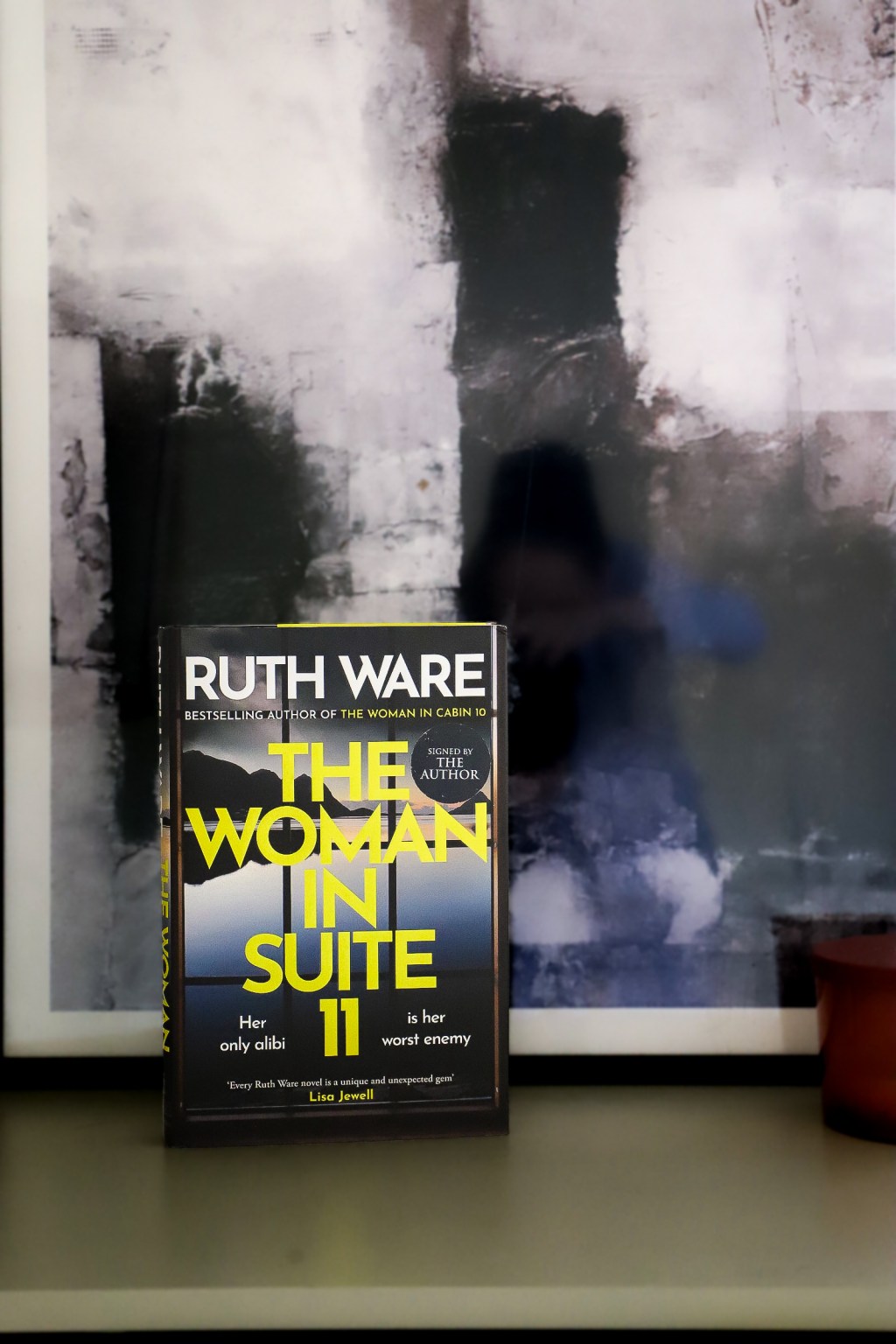
Short answer: no.
I hadn’t read The Woman in Cabin 10 before picking up Ruth Ware’s The Woman in Suite 11 (in fact, I didn’t even know there was another book), and I didn’t feel lost at any point.
This was actually a freebie in one of my Goldsboro Crime Collective subscription boxes, so I went into it with minimal prior knowledge – and without having read any of Ruth Ware’s other books.
And honestly? It worked absolutely fine.
The Woman in Suite 11 is technically a sequel, with travel journalist Lo Blacklock returning as the protagonist, but it gives you enough context to understand her history, relationships and emotional baggage without requiring you to know the first book in detail.
What is the Woman in Suite 11 about?
Lo Blacklock is trying to re-establish her career as a travel journalist when she is invited to the opening of a luxury hotel on the shores of Lake Geneva.
The job should be fairly straightforward. Obviously, it isn’t.
A late-night encounter pulls Lo into something much more dangerous, and from there the book becomes a high-stakes chase across Europe involving secrets, deception and increasingly questionable decisions.
It is very much a plot-driven, twist-heavy thriller, but what I liked is that it still feels anchored in Lo’s personal history and emotional trauma.
So although the pace is fast and the plot keeps moving, there is enough going on underneath it to stop the whole thing feeling completely hollow.
Do you need to read The Woman in Cabin 10 first?
For me, no.
I went into this completely cold and never felt as though I had accidentally started halfway through a story.
You are told enough about Lo’s past for her emotional state and motivations to make sense, and the central mystery in The Woman in Suite 11 is self-contained.
There is always a slight risk with sequels that you spend half the book feeling as though everyone else has been invited to a party you missed.
That didn’t happen here.
Ruth Ware clearly gives returning readers enough continuity to make Lo’s history feel meaningful, while still enabling new readers to get on with the story.
So if the only thing stopping you from picking this up is the fact that you haven’t read The Woman in Cabin 10, I really wouldn’t worry about it.
Lo Blacklock is compelling – and also deeply frustrating
I did enjoy Lo as a protagonist.
But I also spent a fair amount of time wondering what on earth she was doing.
She is incredibly gullible at points and makes some frustratingly naïve decisions that I found difficult to believe – particularly given that she is a mother.
There were several moments where I found myself thinking: “Surely you would not do that.”
And then she did.
From a thriller perspective, obviously some poor decision-making is useful because otherwise everyone would simply leave the dangerous situation and we would have a considerably shorter book.
But there were moments where Lo’s choices stretched my patience. That said, she is never boring. And because the book remains tied to her history and trauma, those decisions at least feel like they belong to a real person rather than to a character who exists solely to move the plot along.
The setting is one of the best things about it
This was probably the strongest part of the writing for me.
The book moves between locations in Switzerland and London, and Ruth Ware writes them vividly enough that I could genuinely picture the scenes unfolding.
The Swiss setting in particular works brilliantly for this kind of thriller.
There is something inherently effective about pairing luxury with isolation – beautiful mountains, money and danger all sitting slightly too close together.
Even when the plot became increasingly frantic, I never lost a sense of where I was. That sounds like a small thing, but in a chase-heavy thriller it matters.
Is it actually twisty?
Yes.
The book is definitely more plot-heavy than character-heavy overall, and the twists are a big part of the appeal.
There are several reversals and reveals, and while I can’t remember now whether I saw every one of them coming, I do remember enjoying the way the story kept changing shape.
It never felt static.
Once the central mystery properly gets going, the pace stays high and the book becomes very easy to keep reading.
Would I go back and read The Woman in Cabin 10 now?
Probably not.
And I actually think that says something useful about how well The Woman in Suite 11 works as a standalone.
I enjoyed this book enough to give it 3.75/5, but I never finished it thinking that I now needed to go backwards and fill in the gaps.
There didn’t feel like there were any gaps.
That doesn’t mean readers who loved The Woman in Cabin 10 won’t get extra enjoyment from seeing Lo again.
But if, like me, you are encountering Lo for the first time in The Woman in Suite 11, I don’t think you lose anything essential.
Final Verdict
You absolutely can read The Woman in Suite 11 without reading The Woman in Cabin 10 first.
It works well as a standalone thriller, gives you enough context to understand Lo, and has its own self-contained mystery.
I found it fast-paced, twisty and surprisingly immersive, with particularly strong setting and atmosphere.
Lo occasionally made me want to confiscate her passport for her own safety, but I was still invested enough to follow her across Europe.
3.75/5
Read this if: you want a fast, twist-heavy thriller with luxury hotels, European settings and a protagonist who will occasionally make you question every decision she has ever made.
Like twisty books that keep you guessing?
Join The Sunday Shelf for weekly reviews, recommendations and whatever bookish rabbit hole I’ve disappeared down that week.
 Books With Megz