
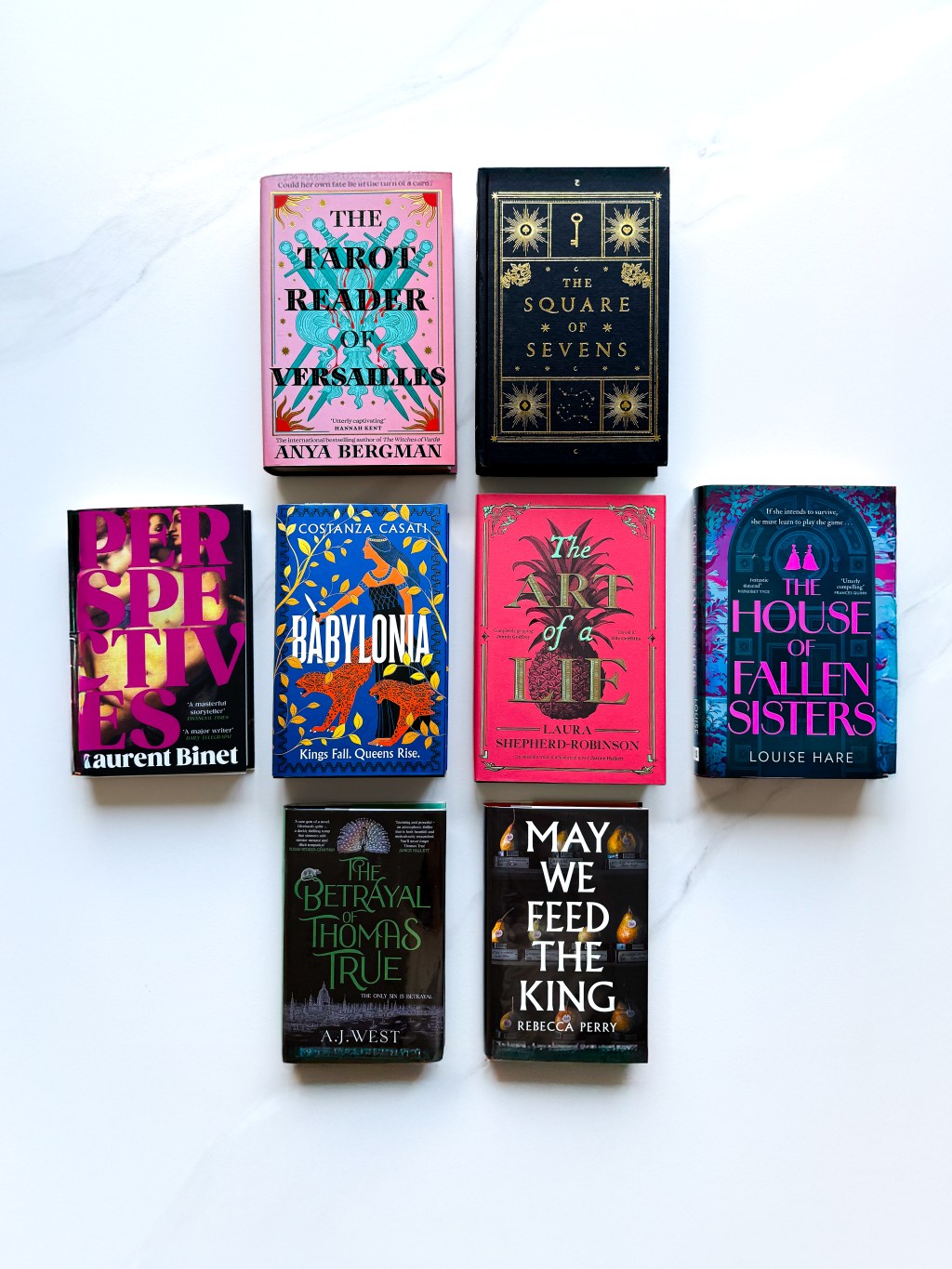
Historical fiction is one of my favourite genres, but I’m quite picky about it.
I want the history to actually matter. I want to feel immersed in a period, understand how people were shaped by it, and come away feeling like the setting was more than just decorative wallpaper.
The books I tend to love most are the ones that combine strong historical detail with mystery, politics, power, complicated relationships or something slightly unusual.
These are eight of the best historical fiction books I’ve read – and the ones I’d genuinely recommend.
This post contains affiliate links. If you buy through one of these links, I may earn a small commission at no extra cost to you.
1. May We Feed the King by Rebecca Perry
Best for: unusual historical fiction and questions about how history gets remembered
This was one of my favourite historical fiction reads of the year because it felt genuinely different.
The novel moves between a modern-day curator recreating rooms in a medieval palace and the story of a reluctant king who never really wanted the role forced upon him. The curator becomes increasingly absorbed in his life while trying to piece together who he really was from the surviving historical record.
What I loved most was the way it questioned how much of history we can actually trust.
So much depends on what happened to be written down, who was doing the writing, and which version survived.
I also really felt for the King. He is not the stereotypical power-hungry ruler at all, he feels much more like someone trapped by duty and circumstance.
It is quiet, strange and very atmospheric, and the writing is beautiful without feeling overdone.
Read this if you like: historical fiction about memory, power and the unreliable nature of the historical record.
Read my full review of May We Feed the King →
Buy May We Feed the King →
2. Babylonia by Costanza Casati
Best for: ambitious women, ancient history and political power
Babylonia reimagines the story of Semiramis, the legendary female ruler associated with the Assyrian Empire, following her rise from obscurity into a world of power, war and palace politics.
This is exactly the kind of historical fiction I tend to gravitate towards: women trying to carve out space for themselves in worlds that were never designed to give them much power.
What I liked most was the scale of it. It feels sweeping, political and ambitious, but still grounded in one woman’s determination not to accept the life that has been handed to her.
The setting also matters because Semiramis sits somewhere between history and legend. Her story has been fragmented, embellished and rewritten over time, which makes a novel about her feel particularly fitting.
That tension between what we know, what we think we know and what has simply survived is something I find fascinating in historical fiction.
Read this if you like: ancient settings, ambitious women, palace intrigue and sweeping historical fiction.
Read my full review →
Buy Babylonia →
3. The House of Fallen Sisters by Louise Hare
Best for: Georgian London, women on the margins and found family
I gave this 4.5/5 and devoured it in a day.
The novel follows Sukey Maynard, a mixed-race young woman living and working in a Covent Garden brothel, in a world where the choices available to women like here are brutally limited.
What I loved most was how unflinching it felt about the reality of life for women in Georgian London. The brothel is both exploitative and, strangely, protective. Of course forcing young women into prostitution is horrific, but the book also makes you understand the reality behind it: without somewhere like this, many of these girls would simply have been on the streets.
I liked that the novel showed Georgian London beyond the usual glamour. Historical fiction about wealthy society can be great fun, but this felt closer to everyday survival.
The Jonathan Strong storyline also added another layer I really enjoyed, particularly because Sukey’s own mixed-race identity gives her a personal interest in his fate.
What stayed with me most, though, was the solidarity between the women. The book does not soften the exploitation, violence or lack of choice, and I appreciated that. Staring directly at those realities gave the women more dignity than pretending the past was prettier than it really was.
Read this if you like: darker historical fiction, social history, and women surviving within systems stacked against them.
Read my full review →
Buy The House of Fallen Sisters →
4. The Tarot Reader of Versailles by Anya Bergman
Best for: the French Revolution with a mystical edge
I gave this 4/5.
The French Revolution is one of my favourite periods of history, so Paris, political upheaval and tarot was always going to be an easy sell for me.
The novel balances two women with unusual abilities: one can see the future, while the other can see the past. That contrast gives the story a really satisfying structure and makes the supernatural side feel properly connected to the history rather than simply added for atmosphere.
I loved the setting, the historical context and the characters, and I thought the tarot element was genuinely interesting.
My only real issue was the pacing towards the end. For a novel set against such a dramatic period, I expected the final stretch to feel slightly more urgent.
Still, it was a really enjoyable read and exactly the kind of historical fiction I tend to pick up.
Read this if you like: revolutionary France, tarot and historical fiction with a supernatural element.
Read my full review of The Tarot Reader of Versailles →
Buy The Tarot Reader of Versailles →
5. The Betrayal of Thomas True by A.J. West
This was a full 5/5 for me, and I read it in a day.
Set in Georgian London, the story follows Thomas True as he becomes part of the city’s molly-house community – spaces where men could meet, form relationships and, for a brief time, live more openly than wider society allowed.
The molly house felt like the emotional centre of the book. It was a reprieve from the fear and pressure these men lived with outside, but that joy always made me nervous too. I was constantly waiting for the house to be raided and for these men to be dragged away and executed.
That contrast made the happiness even more powerful. The book never reduces queer history to persecution. There is humour, friendship, sex, cattiness, loyalty and community as well as brutality.
I felt particularly strongly about Thomas because so much of his story is about trying to work out who he is and then deciding that, despite the danger, he is going to live as much of his true self as possible. There is something incredibly brave about choosing to be yourself in a world where doing that could literally cost you your life.
I also loved his relationship with Gabriel, and the mystery around the “Rat” worked brilliantly. I kept changing my mind about who it could be and absolutely did not expect the eventual reveal.
The Georgian London setting was so vivid that I can still picture parts of it over two years later.
What stayed with me most was how personal the history felt. The laws and attitudes of the period shape who these men can love, where they can go and how much of themselves they are allowed to show.
It made me sad and angry, and by the end I was completely emotionally invested.
Read this if you like: immersive historical fiction, queer history, found family and mysteries where the stakes feel genuinely frightening.
Read my full review →
Buy The Betrayal of Thomas True →
6. Perspective(s) by Laurent Binet
Best for: Renaissance art, murder mysteries and unusual storytelling
This is probably the most structurally unusual books on the list.
Set in Florence in 1557, it follows the murder of painter Jacopo Pontormo and unfolds entirely through letters exchanged between figures including Giorgio Vasari, Michelangelo and members of the Medici circle.
I liked the combination of history and mystery here.
The epistolary structure means you are constantly getting different versions of events, different motives and different perspectives on the same people. Nobody has the full picture so you have to piece things together alongside them.
It also makes the Renaissance setting feel very immediate. Rather than being told about politics, religion and art from a distance, you are effectively eavesdropping on the people caught up in it.
There is a lot going on, and it definitely asks you to pay attention, but that is also part of the appeal.
Read this if you like: murder mysteries, Renaissance Italy, art history and books that experiment with form.
Read my full review →
Buy Perspective(s) →
7. The Art of a Lie by Laura Shepherd-Robinson
Best for: deception, suspicious motives and women underestimated by society
This was a full 5/5 for me.
The premise immediately worked: a woman running a business in a period where that alone makes her unusual, combined with a story built around deception and uncertainty.
I also already knew I loved Laura Shepherd-Robinson’s writing. I have now read two of her books and both have been spectacular.
A huge part of the appeal was not knowing who to trust.
I spent a lot of the book questioning motives and trying to work out what was actually true. I trusted the protagonist for a long time too — which made some of the later revelations especially effective.
The historical setting is important because the assumptions people make about women become part of the story itself: what women are capable of, what society expects from them, and what people simply refuse to believe they could do.
The ending was shocking but also properly wrapped up, which I really appreciated.
Read this if you like: suspicious historical fiction where everyone’s motives deserve a second look.
Read my full review →
Buy The Art of a Lie →
8. The Square of Sevens by Laura Shepherd-Robinson
Best for: big historical mysteries with secrets layered on secrets
This was another 5/5.
It also intimidated me for quite a long time because it is a very big book. I kept looking at it and thinking I needed to be in the right mood to commit to it.
Once I finally did, though, I completely understood why it needed the space.
The story follows Red, a young fortune teller who uses a card-reading system called the Square of Sevens while trying to uncover the truth about her family and becoming entangled with wealthy families and an inheritance dispute.
What I loved most was the gradual reveal.
I thought I understood what was happening for most of the book, and then by the end I realised that so much of what I had accepted as true simply wasn’t.
I was genuinely gobsmacked.
Red was also very easy to root for. She is down on her luck, trying to understand where she belongs, and constantly having to decide who she can trust.
The combination of period setting, storytelling, danger and twists made this a really memorable five-star read for me.
Read this if you like: long immersive mysteries, fortune-telling, family secrets and endings that completely reframe what came before.
Read my full review →
Buy The Square of Sevens →
Which historical fiction book should you start with?
If you want something unusual and literary → May We Feed the King
If you want ancient power and ambition → Babylonia
If you want Georgian London and female solidarity → The House of Fallen Sisters
If you want revolution and tarot → The Tarot Reader of Versailles
If you want queer history and danger → The Betrayal of Thomas True
If you want Renaissance art and a murder mystery → Perspective(s)
If you want deception and suspicious motives → The Art of a Lie
If you want a huge twisty historical mystery → The Square of Sevens
Historical fiction is one of those genres where I am always going to have another favourite waiting around the corner, so I fully expect this list to grow.
For now, though, these are the books I would happily recommend without hesitation.
If there is a historical novel you think belongs on my reading list, I would genuinely love to know what it is.
 Books With Megz