
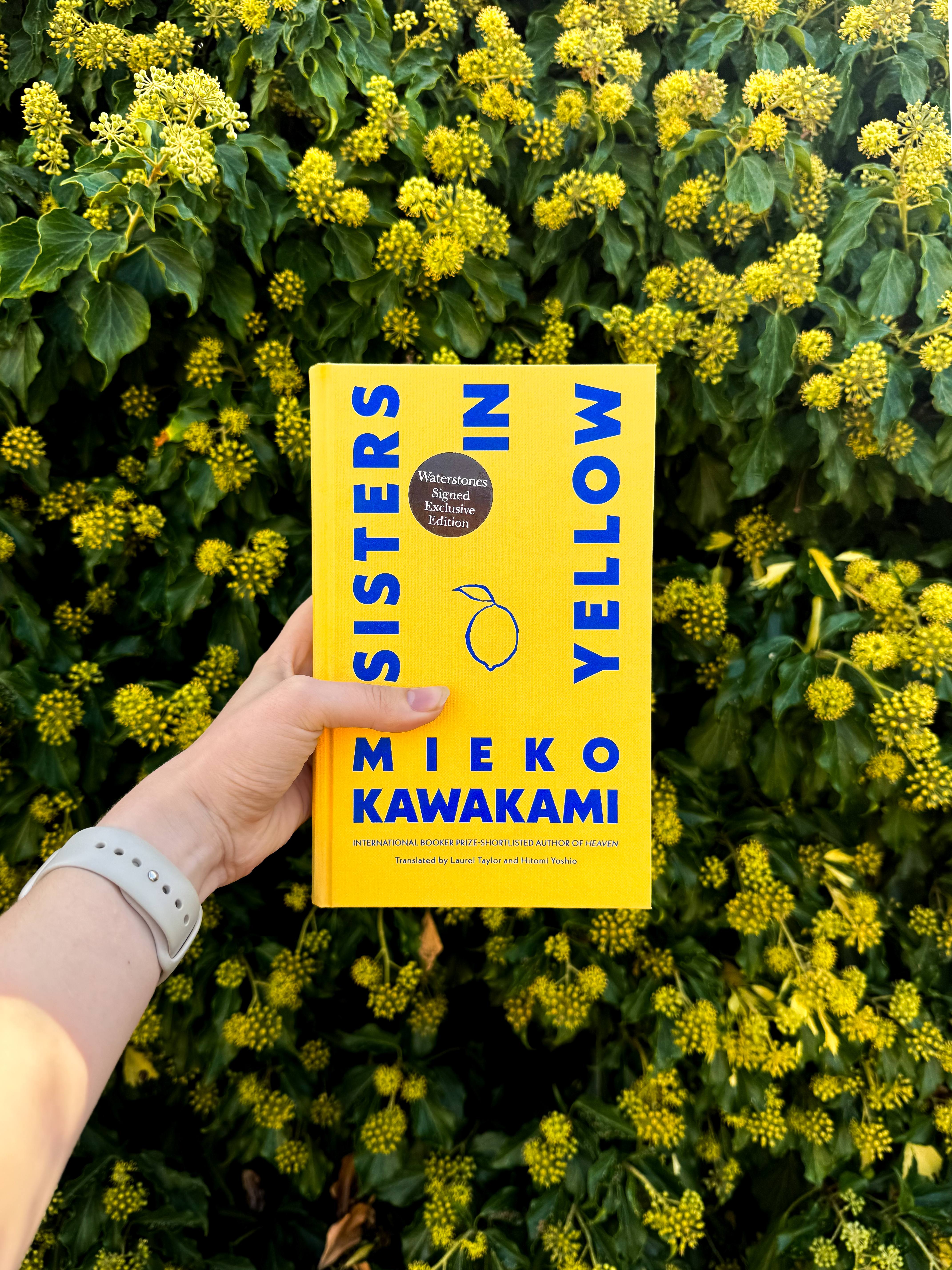
I picked up Sisters in Yellow with International Translation Day approaching. I realised I wanted to make a more conscious effort to read fiction originally written in languages other than English. I’d never read Mieko Kawakami before (in fact, I hadn’t even hear of her) so I went into Sisters in Yellow by Mieko Kawakami with absolutely no idea what to expect.
After the first chapter, I thought I was picking up a twisted, dark crime novel.
We meet Hana as an adult. She has come across a news article about a woman named Kimiko who is taken to court, accused of holding a young woman captive. Hana immediately recognises here. Kimiko was once an enormous part of her life, and seeing her again brings back memories, and guilt, that send us into Hana’s past.
Given the first chapter, I spent quite a lot of the book waiting for everything to become considerably darker.
Instead, Sisters in Yellow is much more of a coming-of-age novel and societal exploration of poverty, female friendship and the lengths people will go to create some form of security when they’ve never really had it.
And once I stopped waiting for the dark crime novel I thought I was reading, I came to appreciate it for what it really was.
Affiliate disclosure: This post contains affiliate links. If you purchase a book through one of these links, I may earn a small commission at no extra cost to you.
Buy Sisters in Yellow on Bookshop.org →
A quick note before we get into it: this review discusses character and relationship developments throughout Sisters in Yellow, including some details from later in the novel.
Growing Up Without a Safety Net
When we first meet the younger Hana, I found it incredibly easy to sympathise with her.
She’s fifteen, lonely and largely raising herself. Her mother is almost permanently absent, either working or drinking and socialising with friends, and Hana has grown up without the stability she sees in other families.
She is also acutely aware of money. Not in the sense that she wants expensive clothes or status or some glamorous lifestyle. Hana wants money because money means survival. It means being able to leave the crumbling tenement where she grew up. It means food, somewhere to live and, perhaps most importantly, not having to depend on anyone else.
Her circumstances have already narrowed her options before she’s really had the opportunity to decide what she wants from life. Rather than concentrating on school, she works because earning money feels more important than qualifications that might help her in some distant future.
Hana isn’t alone in this circumstance. Again and again, Kawakami introduces people choices have been constrained by the circumstances into which they were born. Ran has to abandon beauty school because she and her family need money. Other children grow up with absent parents. The adults around Hana have their own histories of poverty, instability and survival.
That was one of the things I really enjoyed about Sisters in Yellow. Poverty isn’t presented as an unfortunate backdrop to Hana’s individual story. It shapes what these characters believe is possible in the first place.
There is a question running underneath much of the novel: how are you supposed to make all the ‘right’ choices when you’ve never been given access to the things that allow other people to make them?
What Money Can Buy
Money became almost an obsession for Hana, but I never saw her as greedy. All she wants is security.
At one point she hands virtually all of her savings to her mother, despite knowing she probably won’t get the money back. It’s heart-breaking because the roles between them have become so completely reverse. Hana, who is still incredibly young herself, has become the responsible adult.
As the novel progresses, money comes to mean almost everything to here. It can buy food and shelter, but it can also buy time. The ability to rest. The ability to get sick. The luxury of thinking about tomorrow rather than simply surviving today.
Kawakami also explores the uncomfortable relationship between money and power. The person controlling the money inevitably has more control over everyone who depends upon it. Eventually, that becomes Hana.
The Family They Build for Themselves
For a while, Sisters in Yellow is surprisingly heart-warming.
Kimiko enters Hana’s life and offers her something she’s desperately lacking: care. She cooks for her, keeps their home clean and eventually starts up Lemon with her, the bar they run together.
Then Ran and Momoko join them. The four women are completely different. They come from different backgrounds, they’re different ages but they slowly create a family as they have nobody else. Their home becomes particularly important. They fill their Yellow Corner with yellow objects, believing the colour will bring financial good fortune. Hana paints the walls yellow, and the women contribute little yellow trinkets to their collection.
For Hana especially, the house seems to represent proof that she’s finally managed to build what she didn’t have growing up – a home.
But the further I got into the book, the more I started to see the colour yellow differently. Initially it feels hopeful: prosperity, good fortune and the possibility of a better life. By the end though, I saw it more as false hope – a fragile illusion of security.
Hana can paint the walls yellow. She can save every yen. She can work constantly to try to keep everyone together, but none of it can guarantee that the family she’s built will survive.
When Care Becomes Control
This is where my feelings towards Hana became considerably wore complicated.
As their situation becomes increasingly precarious, Hana takes on more and more responsibility. she’s thinking about where they’re going to live, how they’re going to earn money and what will happen next while the others often seem content to assume they’ll somehow work everything out. It was so frustrating to read – I was frustrated on behalf of Hana.
I found Ran and Momoko frustrating at times because Hana was carrying so much of the practical burden while they didn’t seem to be doing enough independently to help her. Hana’s response isn’t always fair either.
Once the women begin making money through increasingly questionable means, Hana controls it. She gives Ran and Momoko salaries, keeps the savings herself and starts trying to control their movements and decisions. The paranoia and fear surrounding losing everything she has worked for has led Hana to turn care into control.
I found myself simultaneously frustrated with Hana and incredibly protective of her. I understood why Ran and Momoko eventually pushed back against here. They’re young women in their own right, and Hana doesn’t have the right to dictate how they live simply because she’s taken responsibility for their finances. And yet, if I’m choosing sides, I probably still side with Hana.
From her perspective, she’s stretching herself extremely thing trying to preserve the home and future they’ve built together, while the people she’s doing it for don’t seem to recognise quite how much responsibility she’s carrying. It certainly doesn’t excuse everything she does, but it made it very easy for me to understand how she got there.
I found myself understanding why somebody behaves badly doesn’t make their behaviour acceptable, but it can make judging them for their actions more difficult.
And Then There’s Kimiko
Even after more than 400 pages, I don’t entirely know what I think about Kimiko.
I think she loved Hana. But I also think she exploited her.
Kimiko initially appears maternal. She gives Hana somewhere to belong and provides the kind of care Hana has never really experienced. But eventually their roles reverse.
Hana becomes the one keeping everything functioning while Kimiko can spend years seemingly doing very little. There’s an uncomfortable dependency there, and at times it’s difficult not to see an element of manipulation in it.
At the same time, I’m not convinced that Kimiko is deliberately orchestrating any of this. She’s clearly struggling with problems of her own, and by the end I was left wondering where Kimiko would have been without Hana as much as I wondered where Hana would have been without Kimiko.
Perhaps both women saved one another, but I think they also both harmed one another. Both can be true at the same time.
That ambiguity makes the ending particularly sad. Twenty years on and Hana still carries the weight of everything that happened between them, yet when their lives intersect again, Kimiko doesn’t even seem to remember who Hana is.
There’s something strangely wholesome about where Hana ultimately finds herself, but that final imbalance between them really stayed with me.
Not Quite the Book I Thought I Was Reading
My biggest adjustment with Sisters in Yelow was accepting that the opening isn’t really promising the kind of novel I initially thought it was. I kept waiting for the story to circle back towards the darker crime suggested by Kimiko’s arrest and for the novel to become more of a thriller.
Instead, the crime elements that do emerge are really another extension of the book’s wider interest in poverty and survival.
It asks important questions such as: what happens when legitimate routes towards security feel unavailable? Where does survival end and exploitation begin? How much responsibility should somebody bear for choices made when their alternatives are extremely limited?
I think I came to appreciate that far more than I would have if Sisters in Yellow had simply become the dark and twisty novel I expected after chapter one.
The quieter everyday moments are important too. Kawakami’s writing is beautiful and rich, particularly in the imagery when describing the ordinary details of Hana’s world, and Laurel Taylor and Hitomi Yoshio’s translation never made me feel as though there was a cultural or linguistic barrier between me and the story.
The pacing was almost perfect, but fell a little bit short. At more than 400 pages, I enjoyed spending this much time with Hana and watching how her relationships developed and changed over the span of the novel, so I definitely wouldn’t say it was too long. But I do think it could have been tightened slightly, especially in a couple of sections where I could feel my attention wandering.
A Story About What Security Really Costs
Sisters in Yellow was a thoughtful coming-of-age story about women trying to create stability in circumstances that have given them very little of it.
It’s about poverty, but also about what poverty does to your understanding of yourself and the choices you believe are available to you. It’s about money as survival, freedom, time and eventually power. And it’s about chosen family without pretending that choosing your family automatically makes those relationships healthy or permanent.
Most of all, though, I think Hana will stay with me. I didn’t always agree with her. Sometimes she frustrated me enormously. But even when she became resentful and controlling, I never really stopped feeling protective of the fifteen-year-old girl who simply wanted enough money to know she’d be okay.
And perhaps that’s why all that yellow ultimately feels so sad.
Hana spends years surrounding herself with a colour she believes will bring prosperity and good fortune, as though enough yellow objects, enough savings and enough determination might finally make her world secure.
But the yellow fails them, because ultimately, security is much more fragile than Hana wants to believe.
I really enjoyed Sisters in Yellow. It wasn’t quite the novel its opening led me to expect, and the pacing occasionally prevented me from being completely absorbed, but I’m glad that my International Translation Day reading pushed me towards my first Mieko Kawakami. I’ve already been browsing for more of her books.
4 / 5 ⭐️
Have you read Sisters in Yellow or anything else by Mieko Kawakami? I’d particularly love to know which of her books I should try next, and whether anyone else came away from this one feeling as conflicted about Hana as I did.
Buy Sisters in Yellow on Bookshop.org →
Looking for more books in translation? Read my International Translation Day recommendations →