
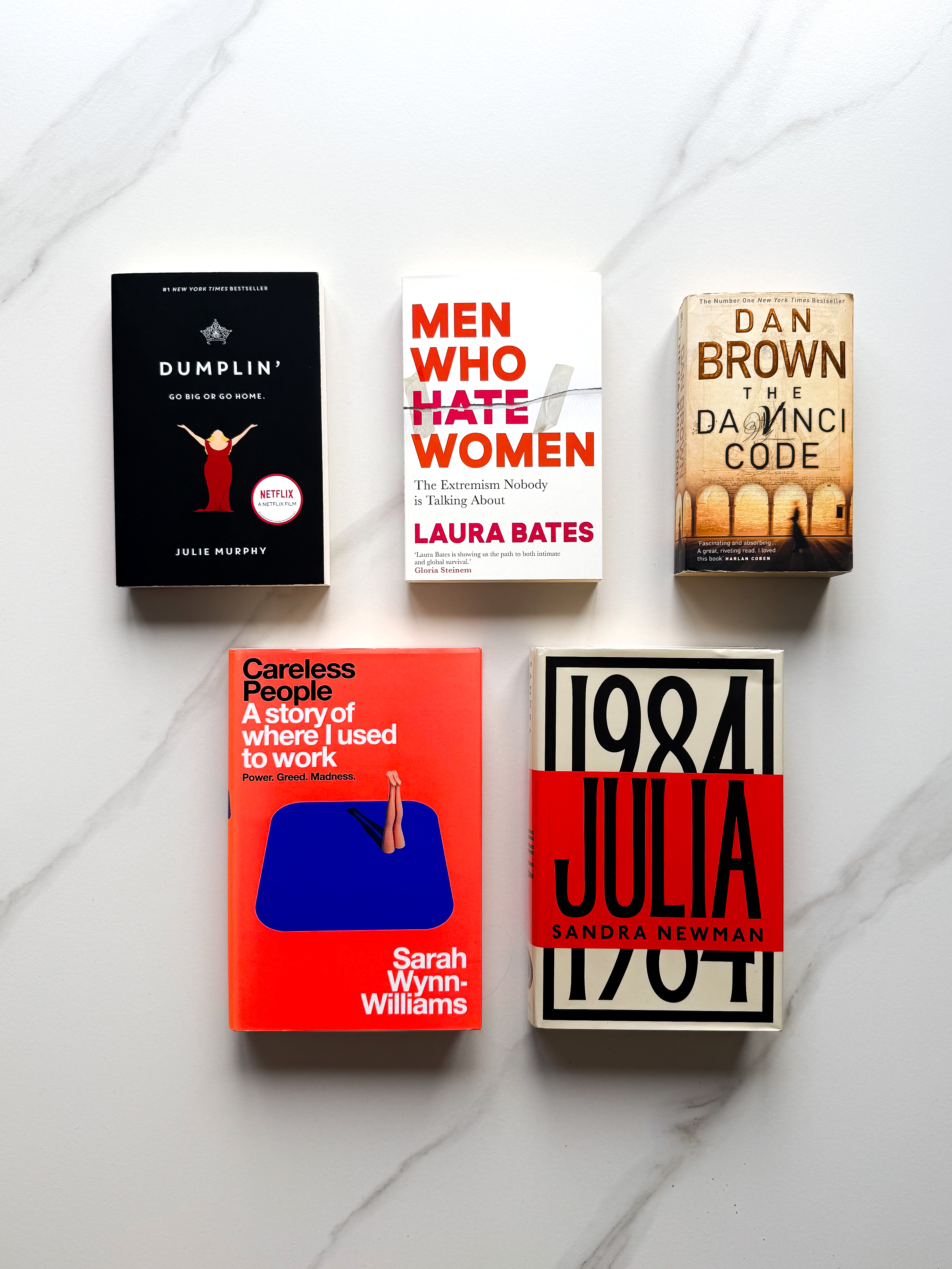
It’s Banned Books Week, which obviously led me to scour my bookshelves for any books that have been banned, challenged, or restricted over the years.
Some of the obvious ones probably won’t come as much of a surprise. 1984, Of Mice and Men, The Handmaid’s Tale, Harry Potter and various Roald Dahl books that have all been challenged or removed from schools and libraries at one point or another.
And this isn’t exactly a historical problem. The American Library Association recorded attempts to censor 4,235 unique titles in 2025, the second-highest number it has ever documented.
But I was more interested in the books I’ve read recently, and what surprised me was how many different forms censorship can take.
A book doesn’t necessarily need to be officially “banned” to have its readership restricted. It might be removed from a school library following a complaint, challenged because somebody considers its content inappropriate, or become the subject of legal action designed to restrict what its author can say about it.
There are books like Sandra Newman’s Julia, which haven’t been censored themselves but exist because writers continue to revisit, reinterpret and give new voices to stories that other people have spent decades trying to suppress.
So, for Banned Books Week, here are five books I’ve read – most recently – that made me think about what the freedom to read actually looks like.
Affiliate disclosure: This post contains affiliate links. If you purchase a book through one of these links, I may earn a small commission at no extra cost to you.
The Da Vinci Code by Dan Brown
Banned
I read The Da Vinci Code years ago, rather than as part of my recent reading, but this was too interesting not to include, particularly as I’ve recently read Dan Brown’s latest novel, The Secret of Secrets.
Dan Brown’s enormously successful conspiracy thriller has faced bans and restrictions in several countries and regions. In Lebanon in 2004, there were significant objections from Catholic leaders to its depiction of Christianity, particularly its suggestion of a relationship between Jesus and Mary Magdalene. Bookshops were instructed to remove copies in English, French and Arabic from their shelves, while further distribution was prohibited.
For a book that became such a huge part of popular culture, it’s strange to think of people being prevented from buying it at al.
Whether you think Dan Brown’s religious conspiracy theories are fascinating, ridiculous or somewhere in between, The Da Vinci Code is fiction. The controversy around it is a particularly clear example of when a fictional interpretation of religion is considered offensive enough that the response moves beyond criticism and into restricting other people’s ability to read it.
Buy The Da Vinci Code on Bookshop.org →
Dumplin’ by Julie Murphy
Challenged
Dumplin’ gives us a slightly different example because a challenge doesn’t necessarily end with a book being removed.
Julie Murphy’s YA novel follows Willowdean, a fat teenage girl who enters her local beauty pageant and refuses to accept the idea that confidence, romance or femininity belong exclusively to women who look a certain way.
In 2019, the book was challenged at Barrie Public Library in Ontario following objections about sexual content, language and whether it was appropriate for younger readers.
The library reviewed the complaint and ultimately decided to keep the book in its teen collection.
While we tend to use “banned books” as a catch-all term, I think it’s important to note that a challenge is still an attempt to restrict or remove a book. Sometimes that attempt succeeds and sometimes it doesn’t.
In this case, the challenge also feels particularly relevant to what Dumplin’ is actually about: a teenage girl taking up space in a world that repeatedly tells her what is and isn’t appropriate for her. I can’t think of a message more relevant to empowering young girls, particularly those who feel they don’t fit the mould of what society expects them to be or look like.
Buy Dumplin’ on Bookshop.org →
Men Who Hate Women by Laura Bates
Removed
This is probably the example that surprised me most because it happened here in the UK, and very recently at that.
Laura Bates’ Men Who Hate Women investigates incels, pickup artists, the manosphere and the online communities in which misogyny can become increasingly extreme.
In 2025, the book was removed from the library at the Lowry Academy in Greater Manchester after the school’s headteacher objected to its content. The decision subsequently developed into much wider controversy around the school’s library collection, with a significant number of other books also removed.
There’s an uncomfortable irony to this one. Men Who Hate Women is most certainly not endorsing the misogyny that it describes – Bates is investigating it.
When I read the book earlier this year, what I found so compelling, and disturbing, was the way Bates traces the journey from online misogyny that can initially seem almost ridiculous to much more serious radicalisation and real-world violence.
Obviously some of the material is uncomfortable – that’s the whole point. But there is a difference between deciding that a book contains difficult material and deciding that other people therefore shouldn’t have access to it.
Read my full review of Men Who Hate Women →
Buy Men Who Hate Women on Bookshop.org →
Careless People by Sarah Wynn-Williams
The author was silenced
This is where the definition of censorship becomes considerably more interesting.
Careless People itself wasn’t banned. Sarah Wynn-Williams’ memoir of her years working at Facebook remained available to buy and her publisher continued distributing it, but Meta pursued legal action based on the non-disparagement provisions in her severance agreement.
In March 2025, an emergency arbitration ruling prevented Wynn-Williams from promoting the book and, to the extent that it was within her control, from further publishing or distributing it.
The restriction did not bind her publisher, Macmillan, which meant readers could still buy the book – the author just couldn’t freely promote or discuss it.
There is something particularly strange about being able to walk into a bookshop, buy somebody’s memoir and then discover that the person who wrote it is restricted from talking about what they wrote.
The situation became even more surreal when Wynn-Williams appeared at Hay Festival in 2026 and sat silently on stage rather than risk breaching the restrictions placed upon her.
It makes Careless People a fascinating example for Banned Books Week precisely because it wasn’t banned.
Restricting ideas doesn’t always mean taking every copy of a book off the shelves. Sometimes the book can remain freely available while pressure is applied to the person responsible for writing it.
Read my full review of Careless People →
Buy Careless People on Bookshop.org →
Julia by Sandra Newman
A banned story, reimagined
Julia is the odd one out on this list.
Sandra Newman’s novel has not itself been banned or challenged. Instead it is an authorised reimagining of George Orwell’s 1984, telling the story from Julia’s perspective rather than Winston Smith’s.
1984 has spent decades being challenged and restricted, and that’s what makes Julia interesting to me. You can attempt to suppress a story, but you can’t necessarily stop what happens to that story afterwards.
Decades after Orwell created Julia, Newman takes a woman originally seen largely through Winston’s eyes and gives her an interior life, perspective and story of her own.
A novel that has repeatedly faced attempts to restrict who can read it hasn’t disappeared. Instead, it has become part of our cultural vocabulary. It can still be interrogated, argued with and rewritten by another author generations later.
Censorship might attempt to stop an idea travelling, but literature has a habit of finding another route.
What actually counts as a banned book?
One of the things I found most interesting while researching this post was how casually we use the word “banned”.
The distinction matters.
The Da Vinci Code was banned. Dumplin’ was challenged, but remained available. Men Who Hate Women was removed from a school library. Sarah Wynn-Williams was restricted from promoting Careless People, while the book itself remained on sale. And Julia shows what can happen decades later when writers continue to engage with stories that others have tried to restrict.
Let Books Be
The theme of Banned Books Week 2026 is “Let Books Be. Protect the Freedom to Read.”
And, frankly, I think anyone who feels genuinely threatened by a book needs to grow up a little.
If you don’t agree with something, don’t read it. If you don’t like particular themes, don’t read them. If a book offends you, criticise it, argue with it, give it a one-star review on Goodreads if you really want to. But deciding that because you object to something, nobody else should be allowed to read it is an entirely different matter.
Reading a book is not the same as agreeing with it.
Keeping a book on a shelf is not an endorsement of everything inside it. And allowing someone else to read something you find offensive, uncomfortable or completely wrong doesn’t require you to read it yourself.
Part of the reason I love reading is because I like learning. I like having my beliefs challenged. I like encountering perspectives I hadn’t considered before and occasionally being forced to rethink something I thought I understood.
Books are a portal into other people’s lives, experiences and ideas. They allow us to understand worlds we haven’t lived in, cultures we haven’t experienced and viewpoints that might be completely at odds with our own. Sometimes that reinforces what we already believe, and sometimes it makes us question it. Both have value.
Which is why banning books feels so intrinsically at odds with what reading is supposed to do.
If books help us learn, question and understand, restricting access to them inevitably restricts some of that opportunity for growth. And when that decision is made on behalf of an entire school, community, or even country, we’re no longer talking about one person’s choice not to read something. We’re deciding which ideas everybody else is permitted to encounter.
Books can make us angry. They can contain ideas that we disagree with. They can be offensive, uncomfortable, badly argued or just plain bad. But we should be able to talk about all of those things. We should be able to criticise them, challenge them and argue about them.
Criticism and censorship are not the same thing.
I’d much rather read widely, encounter ideas I disagree with and decide what I think for myself, and I believe everyone else should be afforded the same freedom.
Have you read any of these? And which banned, challenged or restricted book surprised you most?