
Reading Mood: I want to feel clever
Rating: ★★★★½
Content Warnings: War, terrorism, political violence, coups, execution, invasion, civil conflict, Taliban rule and reference to death.
Quick verdict
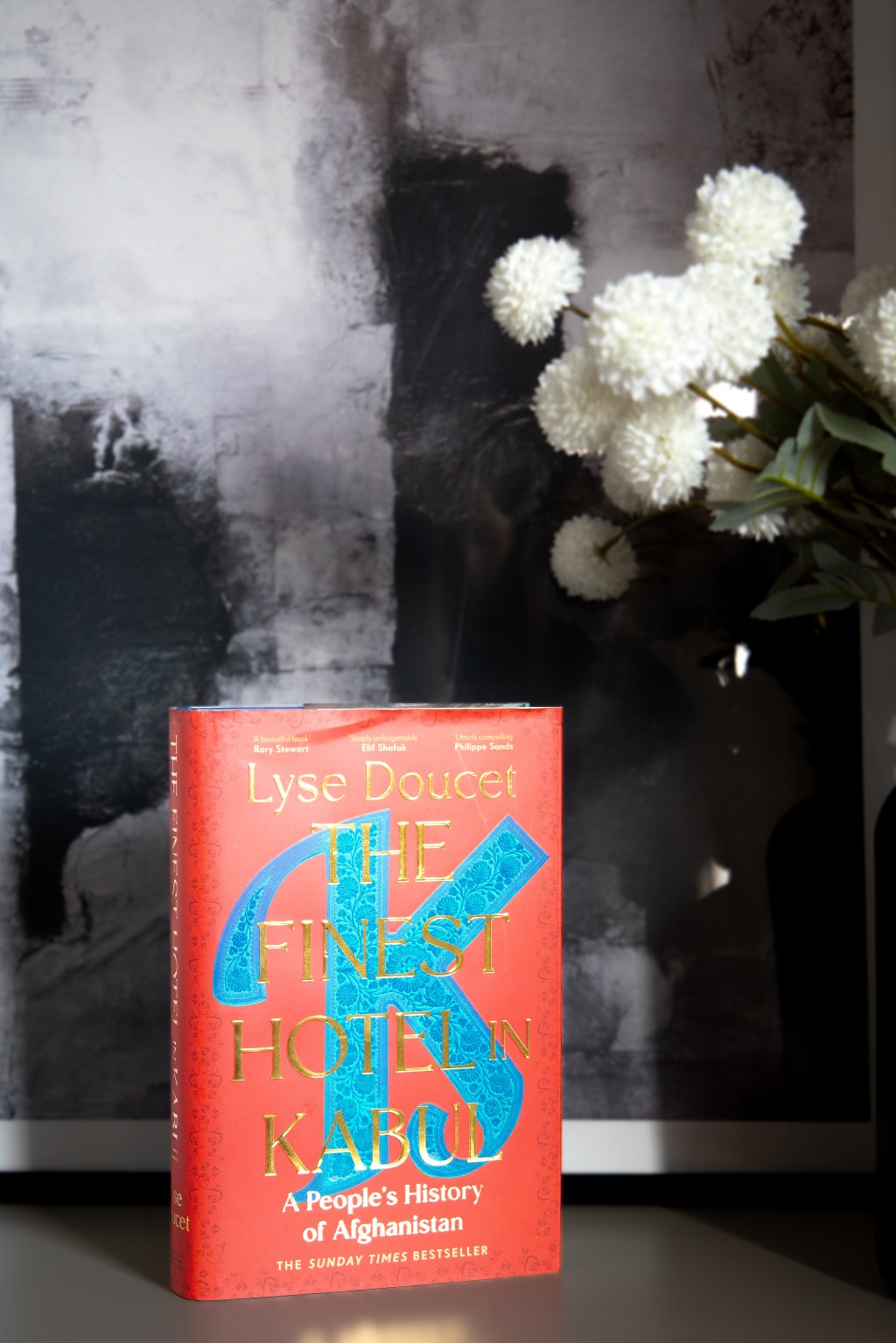
The Finest Hotel in Kabul by Lyse Doucet is a beautifully told, deeply human history of modern Afghanistan, seen through the extraordinary story of the Kabul Inter-Continental Hotel.
I picked this up with very limited knowledge of Afghanistan’s history, and I came away feeling like I had learned so much — not in a dry, textbook way, but through people, places, rooms, conversations, staff members, guests, journalists, soldiers, diplomats, families and survivors.
That is what makes this book so special. It is not simply a political history, although there is plenty of politics. It is not simply a war book, although war runs through almost every page. It is a people’s history, anchored in one remarkable building that somehow keeps standing as the world around it changes, collapses, rebuilds and collapses again.
It is sweeping, intimate, devastating and strangely hopeful.
What is The Finest Hotel in Kabul about?
The Finest Hotel in Kabul tells the story of modern Afghanistan through the Kabul Inter-Continental Hotel, which opened in 1969 as a symbol of optimism, glamour and modernity.
Perched above the city, the hotel began life as a place of possibility: a grand, international space that seemed to reflect Afghanistan’s hopes of being connected to the wider world. But over the decades that followed, it became a witness to almost everything the country endured: coups, assassinations, Soviet invasion, civil war, Taliban rule, American intervention, occupation, insurgency, withdrawal and the Taliban’s return.
Lyse Doucet first arrived at the hotel in 1988 while covering the Soviet withdrawal, and she has returned to it across decades of reporting. In this book, she uses the hotel as a kind of living archive. Through its staff, guests, corridors and history, she tells a much bigger story about Afghanistan itself.
I loved this framing. A hotel is such a clever way into history because hotels are places of movement. People arrive, leave, hide, negotiate, celebrate, mourn, wait, gather, flee, drink tea, exchange rumours, make deals and witness things they never expected to witness. The Inter-Continental becomes more than a setting. It becomes a lens.
A history I realised I did not properly know
One of the reasons this book worked so well for me is that I came to it knowing embarrassingly little about the detail of Afghanistan’s modern history.
I had broad reference points: the Soviet invasion, the Taliban, 9/11, the US-led war, the withdrawal, the Taliban’s return. But I did not have a proper sense of the chronology, the regional context, the political shifts or the sheer number of times Afghanistan has been pulled between competing forces.
Doucet makes that history feel understandable without ever making it feel simple.
The book traces Afghanistan’s unravelling back through the fall of King Zahir Shah in 1973, the coups that followed, the assassinations, the increasing Soviet influence, and then the invasion of 1979. I found the pace of that political collapse both fascinating and horrifying. In just a few years, Afghanistan moved from monarchy to republic to democratic republic, with Soviet influence looming ever larger.
What really struck me was the sense of acceleration. The country does not fall apart all at once. It tips. Then tips again. Then suddenly the old world is gone.
And because Doucet grounds these changes in the hotel and the people connected to it, the history never feels abstract. You see the consequences not only in governments and armies, but in daily life: in who can work, who can travel, who can listen to music, who can gather, who is safe, who has to leave, who stays.
The hotel as witness
The Kabul Inter-Continental is the heart of the book, and what a brilliant narrative device it is.
This hotel has seen everything. It opened as a symbol of ambition and glamour, then lived through war, occupation, civil conflict and Taliban rule. It hosted diplomats, journalists, officials, foreign guests, Afghan families, wedding parties, power brokers, soldiers and staff who kept turning up for work through decades of danger.
That last part moved me most: the staff.
Because although this is a book about Afghanistan’s history, it is also a book about service, endurance and pride. The people who kept the hotel running are not background characters. They are central to the story. They are the ones who remember what the hotel once was, what it became, and what it cost to keep its doors open.
There is something incredibly poignant about the idea of a hotel continuing to function through so much devastation. A place built for hospitality surviving in a country repeatedly torn apart by violence. A place designed to welcome the world becoming battered by the world’s conflicts.
By the end, the hotel feels almost like a character: damaged, dignified, stubborn, exhausted, still standing.
The unique perspective is what makes it so compelling
What I appreciated most was the perspective Doucet brings.
This is not history told only from the top down. Of course, presidents, kings, communists, mujahideen, Taliban leaders, foreign powers and diplomats all matter. But Doucet is just as interested in the people working the front desk, serving tea, carrying luggage, remembering guests, surviving regime changes and adapting to rules that alter their lives overnight.
That is what makes the book so readable. It gives you the big geopolitical picture, but it keeps bringing you back to human beings.
There is a line in the book about it not mattering how big your home is, but how big your heart is. That spirit runs through the whole book. Afghan hospitality, warmth and resilience are not treated as sentimental extras. They are part of the country’s story.
I found that really moving. Especially because Doucet never romanticises suffering. She does not turn endurance into something pretty. She shows the pain, fear and loss, but she also shows humour, loyalty, memory and the astonishing effort it takes to keep going.
1979: the year everything seemed to catch fire
One of the most gripping sections of the book is the build-up to the Soviet invasion and the wider regional chaos of 1979.
Doucet captures how Afghanistan’s crisis was not happening in isolation. The murder of US Ambassador Adolph “Spike” Dubs in the Kabul Hotel in February 1979 was shocking in itself, but the same year saw turmoil across the region: the Iranian Revolution, the hostage crisis in Tehran, the execution of Pakistan’s former prime minister Zulfikar Ali Bhutto after a military coup, and the siege of the Grand Mosque in Mecca.
The region trembled. The world shook.
I found this context incredibly helpful because it situates Afghanistan within a much wider moment of upheaval. It is easy, with limited historical knowledge, to think of Afghanistan’s story as separate or self-contained. Doucet shows how deeply connected it was to the Cold War, regional power struggles, revolutionary politics, religious movements and the ambitions of surrounding states.
That was one of my biggest takeaways from the book: Afghanistan’s tragedy cannot be understood only by looking inward. Again and again, outside powers arrive with agendas, weapons, ideology, money or promises. Again and again, ordinary Afghans live with the consequences.
A book about modernity, loss and return
Another thing Doucet does really well is show how Afghanistan was not always what many outsiders now imagine it to be.
The early chapters are full of a Kabul that feels open, cosmopolitan and ambitious. The hotel’s opening in 1969 reflects a country looking outward. There is development, foreign aid, modernisation, music, fashion, travel, possibility.
That does not mean Afghanistan was some perfect golden age, and Doucet is careful not to make it sound that way. But she does show how much was lost.
This made the later sections even sadder. When the Taliban arrive, when music disappears, when women’s freedoms are curtailed, when punishments become public and brutal, when Kabul feels as though it has been dragged backwards into the past, you understand that this is not an ancient inevitability. It is political. It is historical. It is enforced.
That distinction matters.
One of the things I found most haunting was the way the book captures the strange bargain some people experienced under the Taliban: crime and corruption reduced, but at a horrific moral cost. Quiet came with fear. Order came with cruelty. Safety came with public punishments, repression and the shrinking of life.
Doucet is very good at holding those contradictions without flattening them.
The Taliban sections are deeply unsettling
The sections on Taliban rule are some of the most unsettling in the book.
By the mid-1990s, the Taliban’s control had expanded rapidly, and by the time they took Kabul, the city’s life changed dramatically. Doucet writes about the amputations, executions, bodies hanging in public squares, the disappearance of music, the restrictions on women, the sense that Kabul had been pulled backwards.
Those passages are hard to read.
But again, what makes them powerful is the way Doucet grounds them in lived experience. What does it mean for a hotel to operate in that world? What does hospitality look like under an unforgiving regime? What does professionalism mean when the rules of society have been rewritten? What does survival require?
The Inter-Continental becomes a place where these contradictions meet. It is still a hotel. It is still trying to function. People still need rooms, food, work, shelter, information. But the world outside — and sometimes inside — has changed beyond recognition.
Lyse Doucet’s reporting makes the book feel deeply trusted
This book could only really have been written by someone with Doucet’s depth of experience.
You can feel the decades of reporting behind it. Not in a showy way, but in the confidence of the storytelling. She knows the terrain, the history, the hotel, the people, the silences, the dangers and the limitations of what any outsider can fully understand.
That last point is important. I never felt that Doucet was trying to position herself as the centre of the story. She is present, of course, and her connection to the hotel matters. But the book is not really about her. It is about Afghanistan, and particularly about the Afghans whose lives intersected with this extraordinary building.
There is a humility to the approach that I appreciated. Doucet listens. She remembers. She revisits. She pieces together the stories of people who lived through events most of us only know as headlines.
The result is a book that feels both sweeping and intimate.
What worked less well for me
There is not much that did not work for me, but this is a dense book and there were moments where I had to slow down to keep track of the political timeline.
That is not a criticism exactly — Afghanistan’s history is complicated, and Doucet is dealing with decades of upheaval. But if, like me, you are coming to the book without much prior knowledge, there are sections that require proper attention. This is not one to read while half-watching TV and pretending you are still absorbing information.
I also found myself occasionally wanting a timeline or dramatis personae to refer back to, just because there are so many leaders, factions, invasions, regimes and turning points. That said, Doucet’s decision to keep returning to the hotel helps anchor everything.
Why I’m so glad I read it
I am really glad I picked this up.
It is exactly the kind of non-fiction I love: a book that takes a huge, complicated subject and finds a human way into it. I learned so much about Afghanistan’s modern history, but I also came away with something more emotional than a set of facts. I came away with a stronger sense of the country’s endurance, grief, complexity and humanity.
The book also made me think about the way places hold memory. Buildings can be witnesses. Hotels especially so. They collect stories without choosing them. They host joy and fear, luxury and loss, ordinary routine and world-historical events. The Inter-Continental Kabul becomes a monument not because it is untouched, but because it is scarred.
After multiple coups, invasions, civil war and Taliban rule, the fact that it never fully disappears feels almost impossible.
Bowed, but not broken.
That phrase really captures the spirit of the book.
Final thoughts
The Finest Hotel in Kabul is a moving, immersive and beautifully constructed people’s history of Afghanistan.
It taught me a huge amount, but its greatest strength is not just the information it provides. It is the perspective. By telling Afghanistan’s modern history through the Kabul Inter-Continental Hotel, Lyse Doucet gives the reader a way into an incredibly complex story without reducing that complexity.
The hotel begins as a symbol of possibility: modern, glamorous, international, hopeful. Over the decades, it becomes something else entirely — a witness, a refuge, a target, a workplace, a memory bank, a survivor.
And through it all, Doucet never lets the politics overwhelm the people.
That is what I will remember most: not only the coups, invasions and regimes, but the staff who stayed, the guests who passed through, the families who celebrated there, the journalists who filed from there, the ordinary people who kept living through the kind of history no one should have to survive.
A fascinating, humane and quietly devastating read.
 Books With Megz